ADDITIONAL MATERIALS
Expedition road trip in Mongolia
Tour Dates: July 15 - 31, 2026
Complexity
For today, October 20, 2026, 0 from 6 are available on this tour.
Tour organizers and guides on the route:
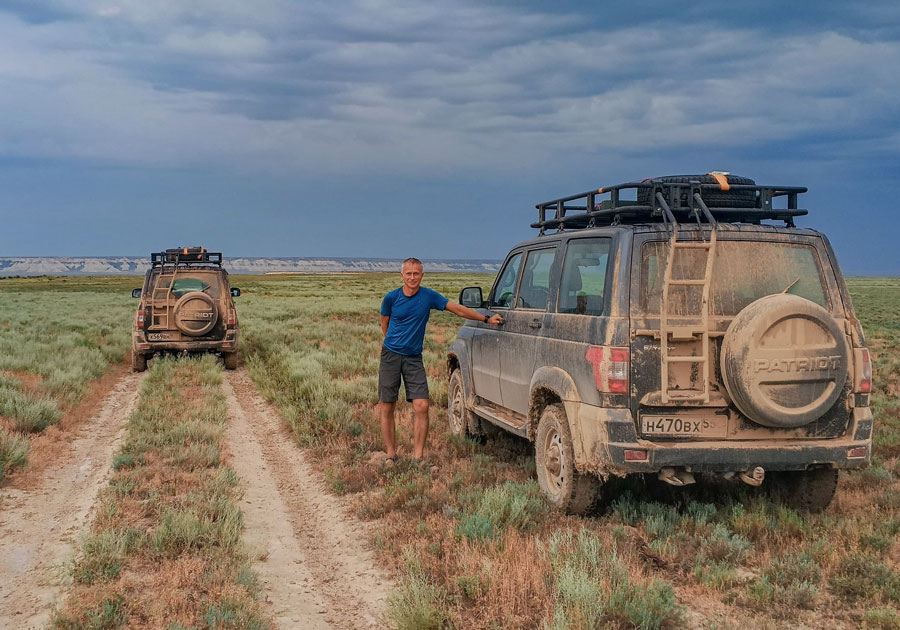
EVGENY ANDROSOV
Professional traveler, climber, mountain guide and tour instructor with 37 years of experience. Has been to all continents, 83 countries of the world and 74 regions of Russia. Organizer of hundreds of author's tours, expeditions, hikes, ascents, creator of many new, non-standard tourist routes...More
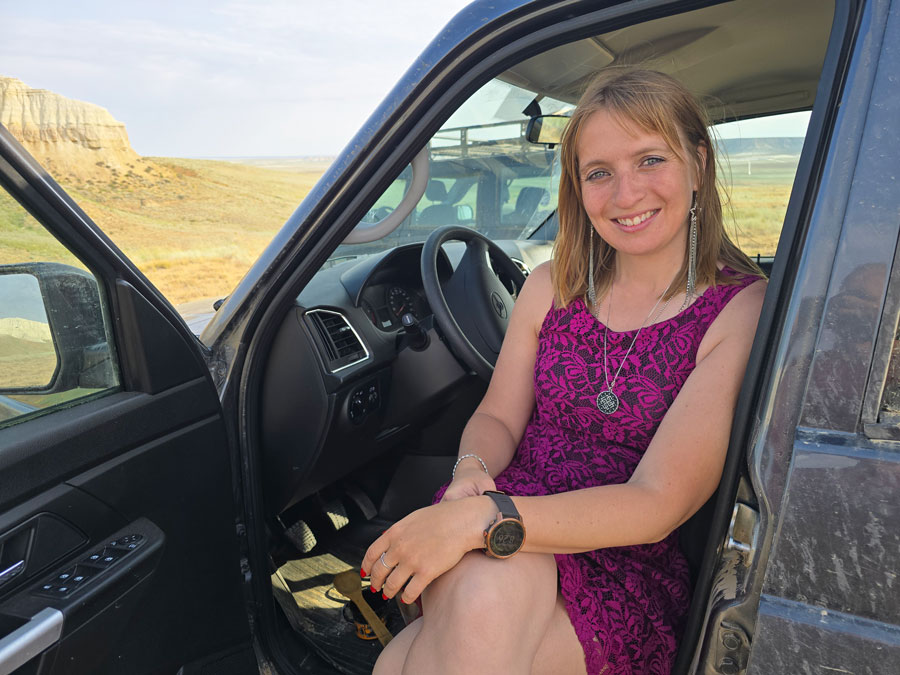
VICTORIA SHATALOVA
Professional traveler, organizer of author's tours with 17 years of experience. Has visited 40 countries of the world and 83 regions of Russia. Organizer and participant of many hikes, rafting, car trips, ascents, including ascent to the highest and most dangerous volcano in Eurasia - Klyuchevskaya Sopka (4850 m), ski trips in the northern and polar Urals, Murmansk region and Kuznetsk Alatau... More
Itinerary day by day:
We meet at the airport of Ulan-Ude at 9:30 in the morning (you need to buy tickets for flights arriving before this time or the day before), get into the cars and head towards the Russian-Mongolian border, to the city of Kyakhta, cross the border and set off to get to know the amazing country of Mongolia. The first Mongolian settlement on our way is the border town of Altanbulag, which is actually an extension of Kyakhta. Then, through the city of Sukhe-Bator, named after the Mongolian revolutionary, we set off towards the endless steppes of Mongolia, among which one of the three largest Buddhist monasteries in the country is lost - the Amarbayasgalant monastery, founded in the 18th century, it miraculously survived the anti-religious campaign of the 1930s and is now under the protection of UNESCO.
We spend the night in tents near the monastery.
We start the day by visiting the Amarbayasgalant Monastery, which has more than 25 buildings on its territory. The largest and most beautiful dugan on the entire monastery grounds is Chogchin, a two-story building with a colonnade and a rich interior, interestingly featuring a large number of dragon images. On a nearby hill is a 13-meter statue of Je Tsongkhapa, a Tibetan religious figure, philosopher, and preacher. Next to the teacher are statues of his two closest students.
In the afternoon, we leave the monastery and head to the natural monument Uran-Togo Tulga-Uul, an extinct volcano. Several thousand years ago, many volcanoes were active on the territory of Mongolia, changing the appearance of the mountains with their eruptions. Now all the volcanoes have aged and become extinct. One of these ancient volcanoes is Uran-Togo. From a distance it can be mistaken for a hill covered with trees, but if you climb its gentle slope, you will find yourself on the edge of a huge funnel, inside which you can see a small lake. The climb to the volcano is not difficult, we will definitely climb it to see the crater with the lake and enjoy the view of the surrounding area.
We spend the night at the foot of the volcano in tents.


We have a relatively long road (more than 350 km) to Ushkiin-Uvur, famous for its Bronze Age cultural monuments included in the UNESCO World Heritage List. We are talking about the so-called deer stones - vertical megaliths decorated with ancient drawings. Unlike similar stones found in other parts of Central Asia, the deer stones of Ushkiin-Uvur have very clear and elegant paintings. The complex consists of 14 stones on two alleys. After examining the ancient stones, we go further, we have to drive another 60 km, after which we will find ourselves on the shore of the beautiful Lake Khovsgol, which is the deepest in Mongolia and deservedly considered one of the most picturesque and clean in the world. It is often called the younger brother of Baikal due to the similarity of origin and belonging to the Selenga River basin. However, Khubsugul is not a miniature copy of Baikal, this lake together with the surrounding landscapes has its own unique charm.
Here we will set up a tent camp. There are tourist bases on the shore of the lake, if there are places, at the request of the group for an additional fee you can stay at one of them.


We leave the shore of Lake Khovsgol and begin a fairly long (about 400 km) journey to the Khorgo-Terkhiin-Tsagaan-Nuur National Park. These places on the northern slopes of the Khangai mountain range are called Mongolian Switzerland thanks to their wooded hills, rivers and lake. Among the attractions of the park is the spectacular cone of the ancient volcano Khorgo Uul and Lake Terkhiin Tsagaan Nuur, formed during the eruption of the volcano by blocking two nearby rivers with lava. In the vicinity of the lake and the volcano there are fields with bizarre piles of lava. It is easy to climb to the top of the extinct volcano, which is what we plan to do.
Overnight in a tent camp on the territory of the national park (it is also possible to stay at the tourist bases of the national park for an additional fee, subject to availability).
Overnight in a tent camp on the territory of the national park (it is also possible to stay at the tourist bases of the national park for an additional fee, subject to availability).
We continue to explore the beauty of the Khorgo-Terkhiin-Tsagaan-Nuur National Park, and then head to the city of Kharkhorin. The city is famous for the fact that in the middle of the 13th century, the capital of the Mongol Empire, Karakorum, was located here. We will get acquainted with the sights of the city the next day, and today we will have a long-awaited, relatively comfortable overnight stay in a hotel or guest house.
Let's go to see the sights of Kharkhorin. Let's start with the Erdene Zuu Monastery. This is the first and largest Buddhist monastery in Mongolia that has survived to this day. It was founded in 1586 on the initiative of the most influential prince of Khalkha, Abtai Khan, opposite the site of the former city of Karakorum. Today, the monastery is an ensemble of 17 temples; the architecture of the complex combines Mongolian, Tibetan and Chinese architectural motifs. After visiting the monastery, we will go to the ruins of the ancient city of Karakorum. The city was located on a branch of the Great Silk Road and was one of its most important posts. On the territory of the ancient city, you can find excavations and the remains of destroyed houses, as well as a stone sculpture in the shape of a turtle and a stone sculpture of a phallic shape, erected, according to legend, as a lesson to the monks. After exploring the sights of the city, we continue our journey along the Mongolian steppes.
We will spend the night in tents far from the city.


Today we will spend the day on the road, stopping along the way to see the ruins of the Ongiin Khiid Monastery. In the 18th–19th centuries, when the monastery was built, over a thousand lamas lived here and 28 temples operated. Ongiin Khiid was an important religious center. The 20th century was tragic for the monastery. During the fight against religion, it was destroyed. At the moment, one temple is operating. We will examine the historical ruins and move on. By the end of the day, we should arrive in the area of an amazing natural monument - Tsagaan Suvarga. This is an incredibly beautiful clay canyon, the name of which means "White Sanctuary" in translation. The unusually shaped white rocks, created by the winds, from a distance resemble the ruins of a destroyed temple building. Overnight in tents near Tsagaan Suvarga.


We explore the beauty of Tsagaan Suvarga and continue our journey. Our next destination is the Ikh Gazryn Chuluu rock massif. The rocky mountains are located on the border of natural zones between the dry steppe and the Gobi at an altitude of 1,560 meters. Here, sandy spaces and polished stone cliffs are combined, their outlines reminiscent of either ancient fortresses and castles, or frozen mythical animals or people. The highest point of the mountain range - 1,706 meters - is Mount Ergul Uul. Many caves and tunnels have been discovered in the rocks. For the Mongols, Ikh Gazryn Chuluu is a sacred place. They often come here to wander among the stone idols and whisper their cherished desires to them. The rocks are especially beautiful at sunset and sunrise.
We spend the night on the territory of the rock massif in tents or camping.


We greet the morning among the bizarre rocks and head to the next natural attraction - the Ikh-Nart Nature Reserve. The reserve has unique rock formations, semi-desert steppes and pastures. Ikh-Nart is home to 33 species of mammals, 6 species of reptiles, 125 species of birds and more than 200 species of plants. Many visitors come to the reserve to observe wild sheep in their natural habitat. We will also take a walk around the reserve in the hope of meeting these animals and admiring the views.
We spend the night in tents on the territory of the reserve.


We leave the Ikh-Nart reserve, today we have about 300 km of travel ahead of us, we will reach almost the Mongolian capital, but about 50 km before it we will turn east to see the huge equestrian statue of Genghis Khan, which is the largest equestrian statue in the world. The uniqueness of the statue is also in the fact that there is an observation deck in the horse's head, which you can climb to.
We spend the night in a yurt camp or guest house.


We continue our journey through the eastern part of the country, these lands are considered the birthplace of Genghis Khan, and there is also very beautiful nature here: steppe valleys, mountains and many rivers. We will make a stop at Lake Khangal in the Khan-Khentiy mountain range. The lake of glacial origin is located at an altitude of 1326 m above sea level and is surrounded by wooded mountains. Berries and rare medicinal herbs grow here. On the left bank of the lake there is a statue of two deer. According to one version, it symbolizes the wild animals that live in this area. And according to another, it is a symbol of the legend of two lovers who, escaping from a formidable father, turned into deer, the nearby rock symbolizes an old man petrified by anger, and the stones breaking off from the rock are his tears. Lake Khangal has always been a place of rest for nomads. We will also rest here: we will walk, enjoy nature and set up camp for the night.
Today we will visit two interesting locations. First, we will visit the Baldan Bereeven Monastery. Founded in 1654, the monastery was one of the main centers of Buddhism in Mongolia in the 19th century. There were fifty temples and four Buddhist schools on the territory of Baldan Bereeven. About 7,000 monks lived here. During the anti-religious campaigns of the 1930s, the temple complex was almost completely destroyed. Now three temples have been restored. In 2012, the Baldan Bereeven Monastery and its surroundings were included in the UNESCO World Heritage List. The monastery is surrounded by beautiful landscapes: the surrounding mountains resemble animals - a lion in the east, a dragon in the south, a tiger in the west, and garuda (the king-bird on which God Vishnu flew) in the north. All four are divine guardians of the shrines. There is a spring and a lake in the clearing opposite the monastery.
After visiting the monastery, we head to the next attraction - the Uglugch wall, which is a fortress 2.5-3 meters high, 2.5 meters wide and about 3 km long, the wall is made of carefully laid stones. It is believed that the wall was built in the 8th century. Scientists have found 60 ancient burials inside the wall, which allowed us to assume that the wall served as a royal cemetery.
By the end of the day, we will arrive in Ulaanbaatar, where we will stay in a good (finally!) hotel.
We will spend the day sightseeing in the capital of Mongolia. We will walk around the central square, visit the Choijin Lamyn Sume temple complex, which now houses the Museum of Tibetan-Mongolian religious art with a very rich collection of exhibits, visit the palace of Bogd Gegen - the last great khan in the history of Mongolia, look into the Gandan Tegchinlin Khiid monastery, founded in 1809 and the only monastery in Mongolia from 1944 to 1990, visit the impressive Genghis Khan Museum (a 7-story exhibition telling the history of Mongolia and containing household items, weapons, jewelry and much more).
Overnight at the hotel in Ulaanbaatar.


A spare day in case of unforeseen situations on the road or falling behind schedule. If it is not needed, we will spend a free day in Ulaanbaatar. On this day, you can independently walk around the city, visit one of the city museums, go shopping for souvenirs or go to the market.
Overnight at a hotel in Ulaanbaatar.
Our journey through Mongolia is gradually coming to an end, we leave Ulaanbaatar, and the road towards the Mongolian-Russian border awaits us, and then to the city of Ulan-Ude.
Overnight at a hotel in Ulan-Ude.
It would be unfair to leave the city of Ulan-Ude outside the scope of our tour, making it only a transit point. After all, there is much to see in the capital of Buryatia. We will devote a day to the sights of Ulan-Ude and its environs. We will walk around the city center, visit the Rinpoche Bagsha datsan, visit the ethnographic museum of the peoples of Transbaikalia - one of the largest open-air museums in Russia, and also take a trip to the main Buddhist monastery of Russia - the Ivolginsky datsan.
Overnight at a hotel in Ulan-Ude.
Transfer to Ulan-Ude airport and flight home.