Namibia | the pearl of Southern Africa
Travel dates: October 9–23, 2027
For today, October 20, 2026, 3 places from 10 are available on this tour.
Trip organizers:
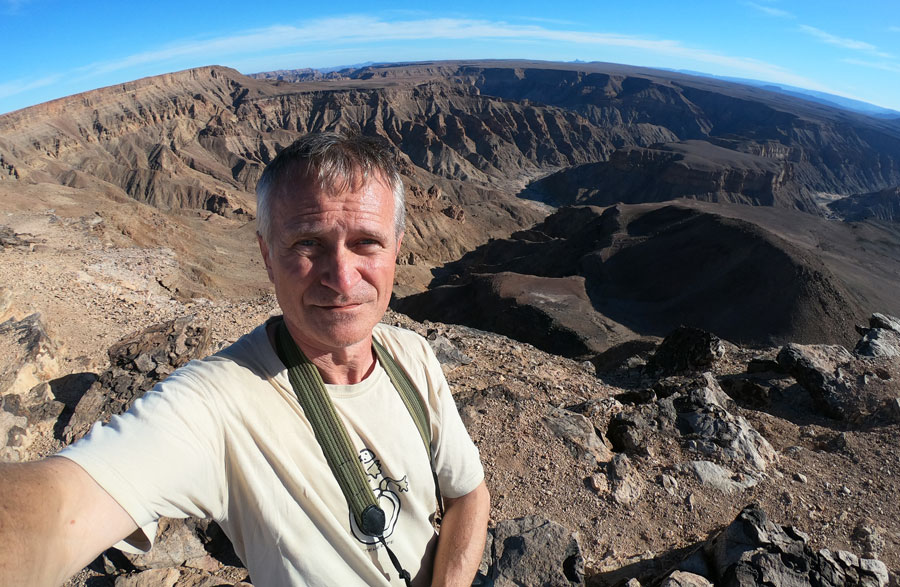
EVGENY ANDROSOV
A professional traveler, climber, mountain guide, and tour instructor with 37 years of experience. He has visited every continent, 83 country, and 74 region of Russia. He has organized hundreds of solo trips, expeditions, hikes, and ascents, and created numerous new, unique tourist routes. Read more

VICTORIA SHATALOVA
A professional traveler and tour organizer with 17 years of experience. She has visited 40 countries around the world and 83 regions of Russia. She has organized and participated in numerous hikes, rafting trips, car trips, and ascents, including an ascent of the highest and most dangerous volcano in Eurasia, Klyuchevskaya Sopka (4,850 m), as well as ski trips in the Northern and Subpolar Urals, the Murmansk Region, and the Kuznetsk Alatau... Read more
Itinerary day by day:
Windhoek
Arrive in Windhoek, the capital of Namibia, transfer to your apartment hotel, explore the city, and enjoy dinner together at a restaurant.
Windhoek - Quiever Tree Forest
In the morning, a car picks us up with our luggage and takes us to a rental car company with special expedition equipment. The vehicle registration process and demonstration of the attachments by company staff takes 2 to 3 hours. Those wishing to drive participate in the acceptance and inspection of the vehicles and equipment, while others relax in the air-conditioned room and enjoy complimentary coffee or tea.
The Toyota Hilux or Ford Ranger vehicles we receive are equipped with everything necessary for a comfortable trip across the country: good off-road tires, two full-size spare tires, two jacks, a tool kit, rooftop tents for camping, sleeping bags and pillows, a large refrigerator, a 30-liter canister of service water, two gas cylinders with burners, a folding table and chairs, a full set of cooking and eating utensils, a power cord for connecting to the campsite power outlets and using the outlets for charging any devices, and much more. We even provide paper towels, matches, dish soap, and kitchen towels. All equipment is of excellent quality.
After picking up our cars and loading our luggage, we'll stop at the nearest supermarket, stock up on groceries and drinking water, and then set off on our journey! Today we'll cover about 500 km on excellent asphalt roads. Our final destination for today is a campsite near Quiever Tree Forest, a forest of amazing trees that have no name in Russian, so they're often called "overgrown aloe" due to the similarity of their leaves to those of common houseplants.
Immediately upon arrival, we'll park our cars at our future campsite and head out for a photo shoot in the forest, which is only 50-100 meters from the campsite. By the time we arrive, it should be sunset—the most beautiful time for photo shoots in this amazing forest.
After the photo shoot, we'll pitch our tents on the roofs of our cars, cook dinner, and eat it under the incredibly bright starry sky! You won't be surprised anywhere else in the world to see such a bright Milky Way overhead - guaranteed!


Fish River Canyon
In the morning, at dawn, those who wish to go again head to the Quiever Forest for a photo shoot. Afterwards, we prepare breakfast together, eat it, pack up the tents and equipment, and set off for the Fish River Canyon—one of the largest and most visited natural attractions in Namibia and all of South Africa.
The road today is almost half as short as yesterday, but part of it is unpaved. Compared to Russian dirt roads, Namibian ones are of excellent quality; in some sections, you can reach speeds of 110-120 km/h, with an average speed of 80-90 km/h. However, since the country's climate is arid and rain is extremely rare, there will be a lot of dust!
On the way to Fish River Canyon, we'll stop at a man-made oasis consisting of a hotel, a café, a souvenir shop, and a garden of quiver trees, surrounded by a large collection of vintage cars, collected and purchased from farmers throughout Namibia. Here you can enjoy coffee or refreshments, relax, and take lots of interesting photos.
We arrive at the canyon after lunch and drive to several viewpoints. We'll reach the last ones at sunset, so amazing photos are guaranteed!
Afterwards, we'll arrive at a campsite near the canyon and, like last time, settle in for the night – we'll pitch our tents, cook dinner together, and eat it under an incredibly beautiful starry sky.
All the campsites we'll be staying at in Namibia, except one, have toilets, showers, running water near the campsite, and power outlets with standard plugs. Some campsites, including this one, even have a small swimming pool!
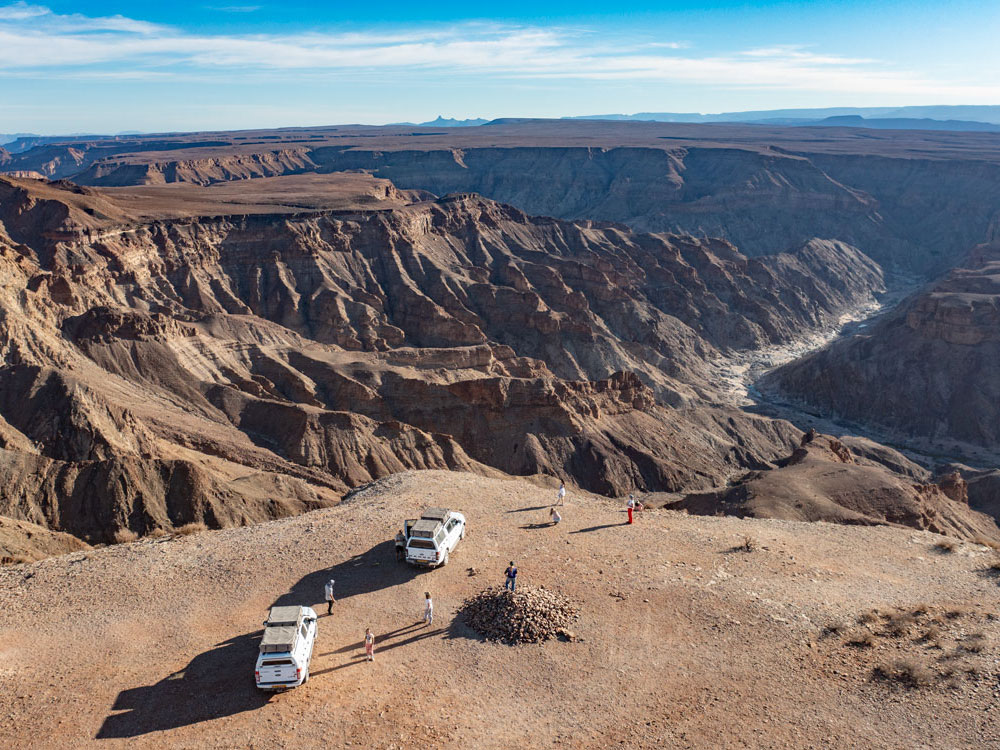


Fish River, Ai-ais National Park and the Orange River
We prepare breakfast, keeping our guard up, as a troop of baboons lives near the campsite, and they're just waiting for a moment when people are distracted to steal food, and sometimes more. In 2023, a baboon stole three packets of pasta from us, which we were planning to use for breakfast—a small loss, even amusing, but it could have been worse—monkeys can steal much more valuable things.
After breakfast and packing, we set off on a short (68 km) drive to Ai-ais National Park, where we'll swim in the hot springs and take a short (a couple of hours) trek along the Fish River (or whatever the Russian translation is?).
After returning from the trek, we get back in the car and drive another 80 km. At the Norestshama River Resort, located on the banks of the Orange River, which forms the border with South Africa. We're in the very south of Namibia!
We're checking into our resort cabins, but we're in no rush to relax – today we're visiting another interesting place – the King's Throne Canyon (what a simple name!). At the resort, we receive a voucher for the canyon and drive to the nearby village of Aussenkehr, where we pay for the entrance fee and receive a key to the gate. Afterwards, we head into the canyon. It's very interesting and picturesque: stone columns, bizarre figures and stone sculptures – simply beautiful!
After admiring the beauty, we return to Aussenkehr, return the key, and return to our resort. We admire the sunset over the Orange River right from the verandas of our cabins, go to a restaurant for dinner, and with our dinner (excellent steaks and springbok medallions), we order wine from the winery whose owner also owns our resort. It's very good!

Route C13 and Lüderitz
Today we'll cover over 400 km, much of it on dirt roads. But the challenges of the journey will be offset by the incredible, stunning landscapes, one after another, compelling us to stop and take photos almost every kilometer! After all, we're driving along the C13, considered one of the most beautiful roads in Namibia!
Overnight at a guesthouse or hotel in Lüderitz. Participants can choose to dine at a Portuguese restaurant for oysters and other seafood.
Kolmanskopp and the Long Journey Through the Desert
At dawn, we'll run to take photos at the lighthouse on Shark Island (though it's not an island, but a peninsula). Then we'll have breakfast at one of the few cafes open from 8:00 AM, take a quick look at the town's colonial architecture, and head to Kolmanskopp, an abandoned diamond mining town covered in sand and whose photos you've probably seen online. It's only 20 kilometers, so we'll be there in just 15 minutes and spend 2.5 hours exploring.
Then we'll set off on the longest and most difficult journey of our entire trip – a dirt road through the deserted desert to Namibia's most famous and visited landmark, Sossusvlei. We'll arrive at sunset or even after dark and head straight to a nearby campsite for the night.


Sossusvlei и Deadvlei
We'll spend the entire day exploring the stunningly beautiful and unique world-famous sights of Sossusvlei and Deadvlei. But we won't rush, as they attract a huge number of tourists in the morning, including large tour buses. We'll sleep longer, leisurely prepare breakfast, and savor it. You can shower and/or swim in the campsite pool. Then we'll pack up our tents and gear, and drive to Sossusvlei.
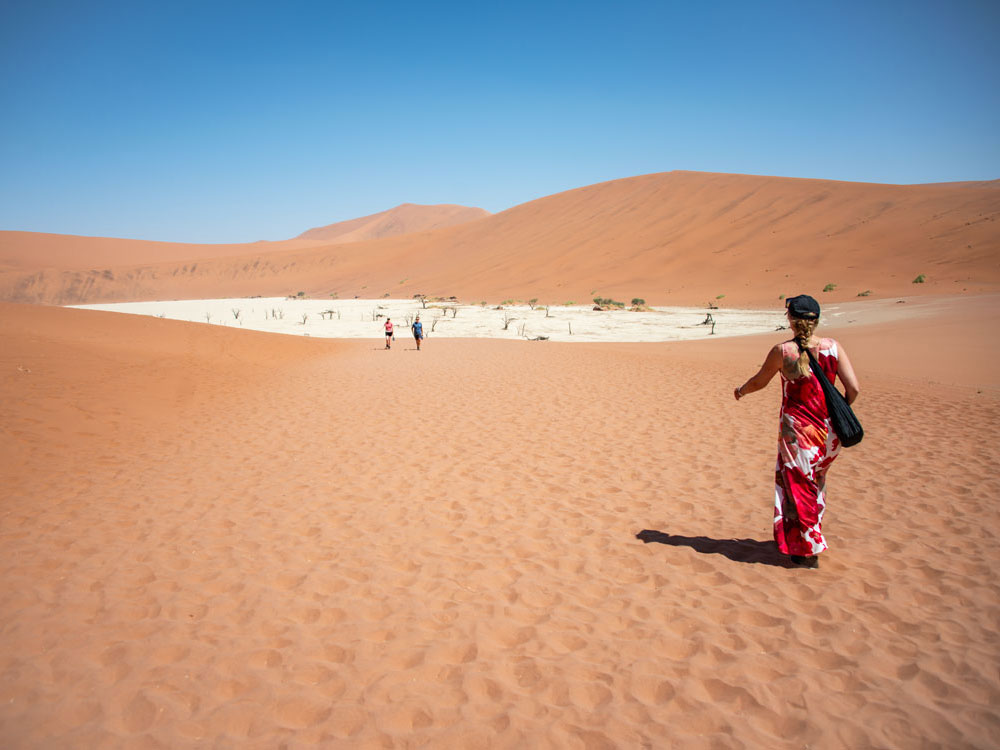
The name Sossusvlei is of mixed origin and roughly means "dead-end swamp." Vlei means "swamp" in Afrikaans, and sossus means "no return" or "dead end" in the Nama language. Sossusvlei owes its name to the fact that it is the endorheic catchment (i.e., a drainage basin without runoff) of the ephemeral Tsauchab River. Essentially, it's a salt-clay basin surrounded by high red dunes, located in the southern Namib Desert, in Namib-Naukluft National Park. The name "Sossusvlei" is often used in a broader sense to refer to the surrounding area, spanning tens or even hundreds of square kilometers.
Here we'll visit Deadvlei, the Dead Valley, whose photographs are a signature feature of Namibia, and climb several red sand dunes. You'll have millions of photos—prepare your phones and camera cards. You'll also be filled with impressions and emotions—this place leaves no one indifferent!
In the evening, after sunset, we'll return to our campsite, cook dinner, and admire the starry sky.


Walvis Bay
We'll continue on dirt roads through the desert – almost 300 km before reaching the asphalt, and then another 50 km to the town of Walvis Bay. In the town of Solitaire, we'll stop to enjoy a signature apple pie and some unique souvenirs, and we'll also stop at a unique rock ridge that you can climb to take in the vast desert surrounding us.
In Walvis Bay, we'll stay at a hotel and shower to wash off the road dust and desert sand.


Pink Lakes, a lighthouse on a sandy cape, and the town of Swakopund
In the morning, we'll drive to the small cape called Pelican Point. It's not a long drive, but it's sandy and off-road, so we'll have the opportunity to test the off-road capabilities of our vehicles and drivers. Along the way, we'll see and photograph the pink lakes of the salt pans and the flamingos that inhabit them in large numbers.
Afterwards, we'll return to Walvis Bay and drive 70 km from there along a good paved road with decent traffic for Namibia. We'll head to Swakopund, where we'll stay at a hotel again and then explore the town.
Swakompund is a resort town with charming colonial architecture and numerous restaurants, including one on a small, beautiful promenade. There's a lighthouse and a large market where black Africans from Namibian tribes sell a wide variety of souvenirs—semi-precious stone and leather goods, animal figurines, and much more. For a small fee, you can take photos with colorful characters in traditional dress. Dinner can be either seafood or a traditional German pub with generous portions of steaks, ribs, and good, inexpensive South African wine.
Skeleton Coast and Spitzkoppe National Park
In the morning, after breakfast and checking out of the hotel, we'll drive 60 km along the coastline, which is part of the Skeleton Coast, passing the first shipwreck on the coast, the most modern and easily accessible. The ship lies aground in the surf zone, 50 meters from the shore, and has become home to thousands of cormorants, who have built nests on it. If the weather is good and you're feeling adventurous, you can swim in the ocean here, although it's not particularly welcoming or warm.
Afterwards, we'll return to the town of Swakopund and from there, along a well-paved road leading to Windhoek, we'll drive to Spitzkoppe National Park. 200 km of asphalt and a bit of dirt road, and we'll find ourselves in a realm of unusual mountains and incredible stone arches. We spend several hours exploring the area, mostly taking photos against the backdrop of all sorts of bizarre and spectacular natural wonders. If time remains, we'll visit "Bushman's Paradise"—a specially protected area of the national park where Bushmen rock paintings dating back some 4,000 years have been preserved. This area can only be accessed with a local guide, who will tell you many interesting things, including the paintings and the unusual clicking language of the Tamara tribe who currently inhabit these parts.
We'll stop for the night at a specially designated site near the famous arch, so we can visit it and take photos at sunset, sunrise, and even at night! It's not exactly camping; the only amenities here are a rather inconvenient toilet and a barbecue area. But they're not really needed near such a fantastic natural landmark. Moreover, we have everything we need except electricity and running water.


Etosha National Park
A long drive to Etosha National Park. Today we'll cover 500 km, and by late afternoon we'll arrive at Okaukuejo Camp, where we'll obtain a permit and pay the park entrance fee. We'll also spend the night here.
Etosha National Park: Rhinos, Giraffes, Zebras, and Everything Else...
Etosha National Park is the oldest national park in the country and one of the most protected areas in Africa. It was designated a game reserve in 1907 and a national park in 1958. In the Ovambo language, "Etosha" means "big white place." This inhospitable region was originally inhabited by the Heli/Omlemoi people, well-known hunter-gatherers who coexisted harmoniously with the vast herds of wild animals in the area. European explorers Charles Andersson and Francis Galton heard the name from nomadic Ovambo traders and decided to reach the area. In 1851, they reached a cattle camp called Omutyamatunda, where Namutoni Campsite now stands. These two explorers provided the first written account of Etosha.
We spent the entire day driving around the park, observing a wide variety of animals from the car window: elephants, rhinos, giraffes, zebras, antelopes, dozens of different birds and small animals. In the evening, we returned to our campsite.


Windhoek
Another long, long drive across the country (about 500 km), this time our last – we return to the capital, Windhoek. We immediately return the cars and transfer our luggage to a minibus, which will take us to an aparthotel in the city center. A farewell dinner at one of the restaurants.
Home!
Transfer to the airport and flight home. It's a long way—two or three plane transfers—and during that time we'll have time to look through the photos on our phones and catch up on all the things we have to do back home. But that's life—all good things come to an end, only to... begin again! See you there, Africa!
Travel map:

Organizational fee: € 2950
The registration fee includes::
The registration fee is NOT included.: