Travel blog
Under the Baikal Stars...
Actually, the whole idea for this hike began with the emotion evoked by a pendant I found in the shape of Lake Baikal. I found it on the banks of the Bolshaya Khadata River in the Polar Urals during a summer hike to Konstantinov Stone (I've already written about it here, by the way: https://androssov.com/ru/blog/post.php?id=19). And since at the time I was looking for an interesting winter route, I concluded that it was a sign.
The last time I was on Lake Baikal was in 2022, which seems like a short time ago, but I've already missed it. Back then, it was a winter hike along the coast of Olkhon Island. It was beautiful, even very beautiful, but those were the most obvious and popular spots among tourists. This time, I wanted something more unique, and I found it. Looking at a map of the lake, it's hard not to notice a large, interestingly shaped peninsula on its eastern side (the Buryats call it Sturgeon's Face), Lake Baikal's largest peninsula, Svyatoy Nos. Based on previous trips, and having become familiar with Baikal's natural environment, looking at the peninsula's rocky shoreline, which is in places jagged with bays, it was easy to conclude that all the winter beauty of Lake Baikal, in the form of blue ice floes and picturesque splashes, was sure to be present in these places. So, the route was chosen – we were going around the Svyatoy Nos Peninsula.
On March 17, 2026, three of us (Olga, Marina, and me) began our hike from the village of Ust-Barguzin, which, to save money, we reached by regular bus (a four-hour journey from Ulan-Ude with a stop at a canteen for lunch). After spending the night in a hotel on the banks of the Barguzin River, we set out in the morning right from its threshold.
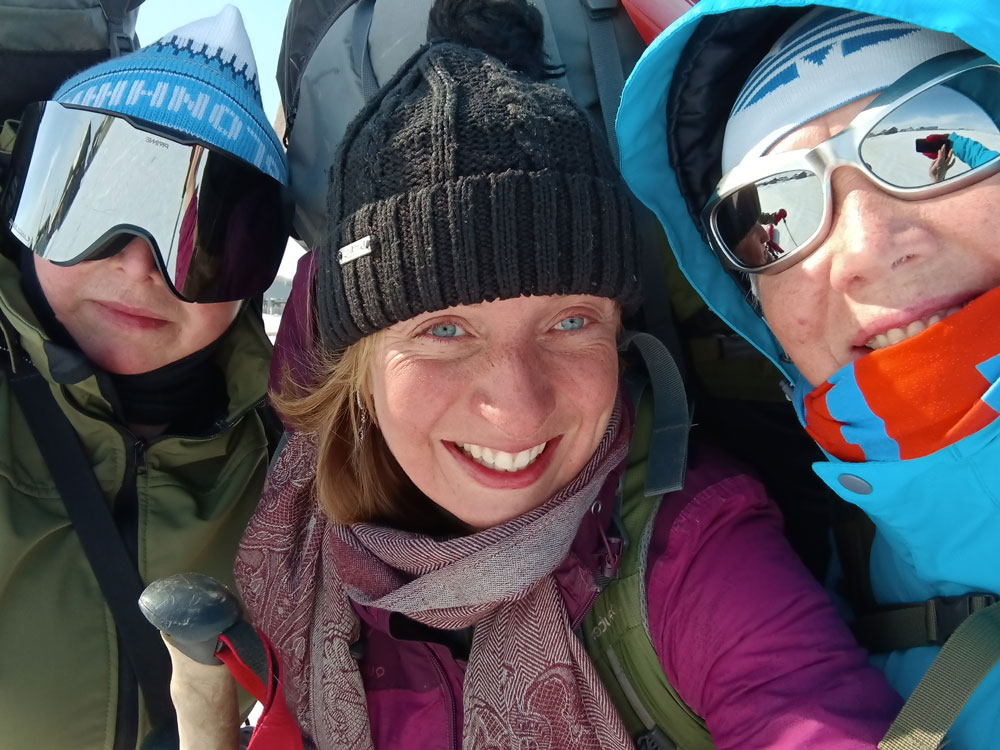
After crossing the Barguzin River on ice and walking a couple of kilometers, we find ourselves at the Zabaikalsky National Park cordon. We obtain entry permits, and here our first unexpected bonus awaits – a fascinating story from an employee of the national park's information center, who gave us a comprehensive account of the lake's nature, history, geology, flora, and fauna. It was especially gratifying that she had walked the entire Baikal coastline on various hikes, so our conversation was on the same page and quite engaging. We spent about an hour at the information center, running a bit behind schedule, but we never regretted it – the story was so engaging.
As for the hiking route, the first day was straightforward: we walked along a road through a sunny pine forest, periodically yielding to passing vehicles and wondering where they were going, since the Svyatoy Nos Peninsula, where the road led, had no infrastructure other than a couple of settlements with a combined population of no more than 100 and a national park cordon near the hot springs in Zmeinaya Bay (we would learn later about the road leading across the ice of Lake Baikal, likely to settlements on the other shores). The forest itself through which we walked was moderately picturesque, but not particularly unusual or impressive. It was mostly a technical crossing necessary to reach the Chevyrkuisky Isthmus, which connects the mainland with the Svyatoy Nos Peninsula.
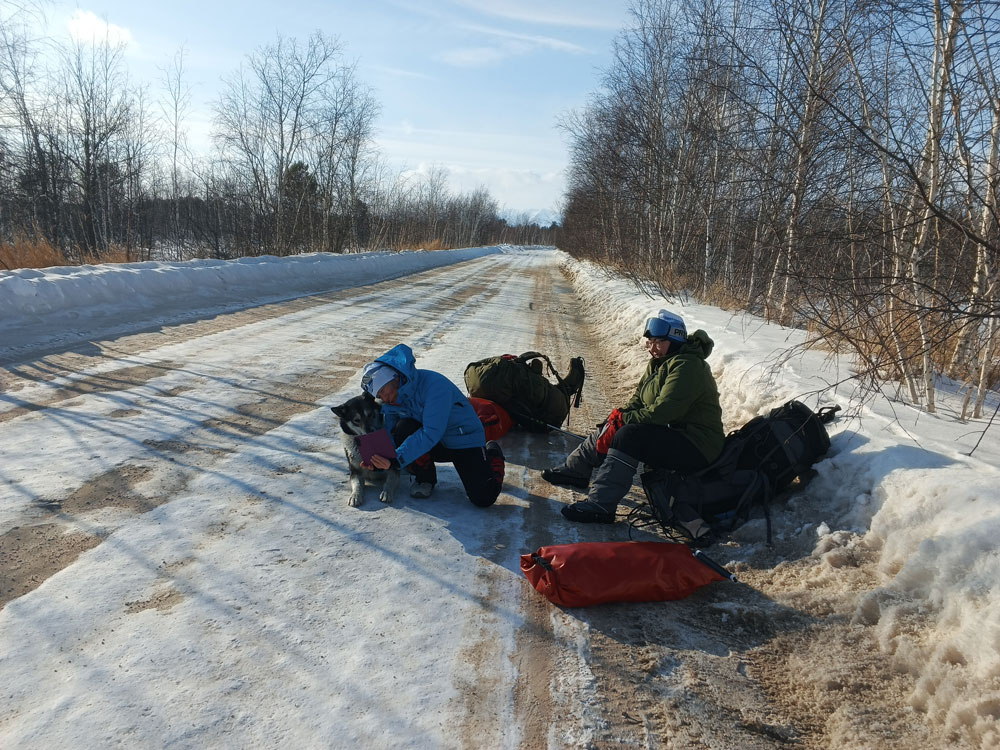
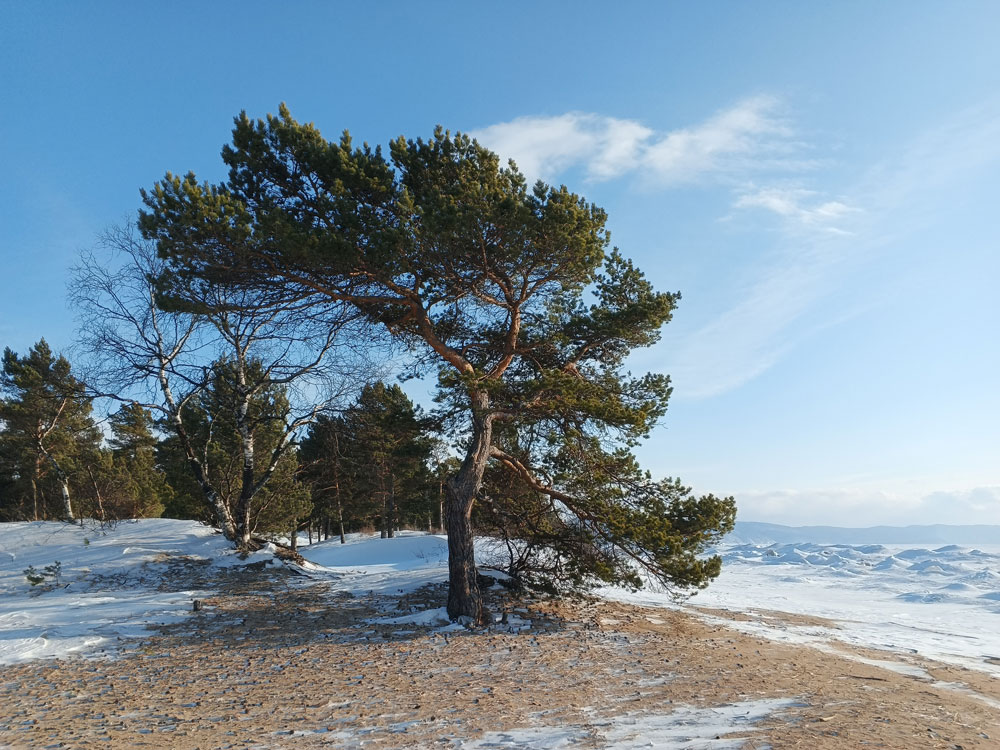
One ??interesting thing was that a dog followed us from the hotel. The dog was very friendly, but we were concerned that our rations for a dog slightly smaller than me hadn't been included in our travel kit. The dog had been following us for about seven kilometers, and during a snack, it practically stared at us. Luckily, some national park employees driving the opposite direction took an interest in us. They stopped, checked our permits for entry into a specially protected natural area, and asked if the dog was ours, informing us that being with animals in the national park is prohibited. We explained that the dog had only a tangential connection to us and wouldn't mind getting rid of it ourselves. We risked offering to let the national park employees take the dog with us. Surprisingly, the dog didn't require much persuasion; he eagerly jumped into the car and drove off to Ust-Barguzin. We reached the Chevyrkuisky Isthmus and reached the shore of Lake Baikal. It was truly beautiful here. The sandy shore was partly snow-covered, partly bare, lending brightness and contrast to the landscape. Pine trees with wide, branching crowns grew on the sand, and the sky was perfectly clear and blue.
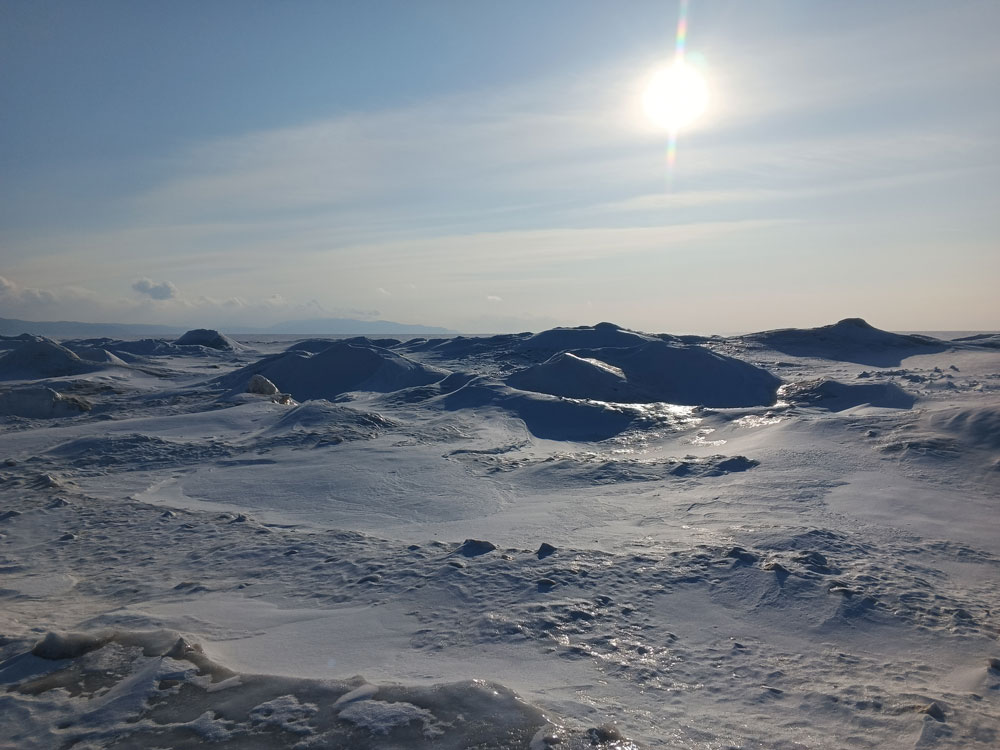
The lake's surface is covered in snow, and the shoreline is covered in snow-ice cones. This pronounced relief creates a play of light and shadow on a sunny day. Beautiful.
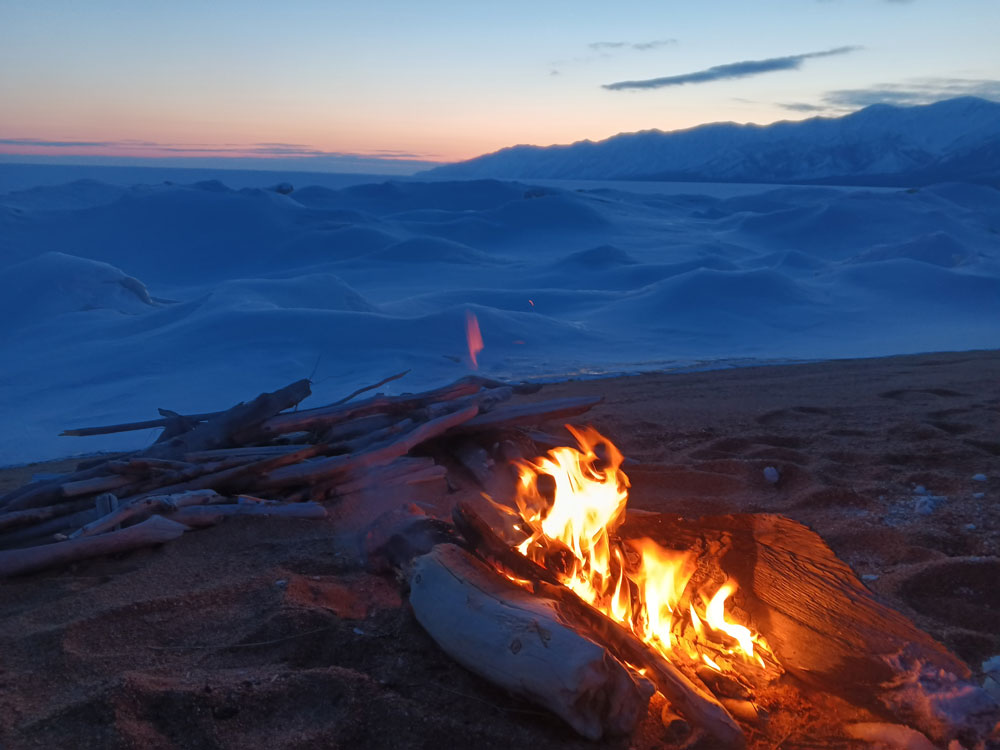
The "Kacheli" camping area is located where we disembarked. It seems there really was a swing there once; the stand remains, but it's no longer functional. It's a shame, though: swinging on a giant swing with a view of Lake Baikal would have been wonderful. The camping area, with tables, fire pits, and designated tent sites, is impressive in its scope and hints at the incredible number of tourists here in the summer, making it all the more pleasant to be here in winter, surrounded by peace and solitude. We chose a spot for our tent and lit a fire. There was plenty of firewood, as there was a lot of driftwood along the banks. This is a relief, as the weather is frosty (around 20 degrees Celsius at night), and gas burns poorly in such weather. Besides, a fire isn't just a means of cooking; it also provides comfort and warmth. On our 2022 trip to Lake Baikal (incidentally, the frosts were even harsher then, and our equipment was worse), our only escape was sitting around the fire.
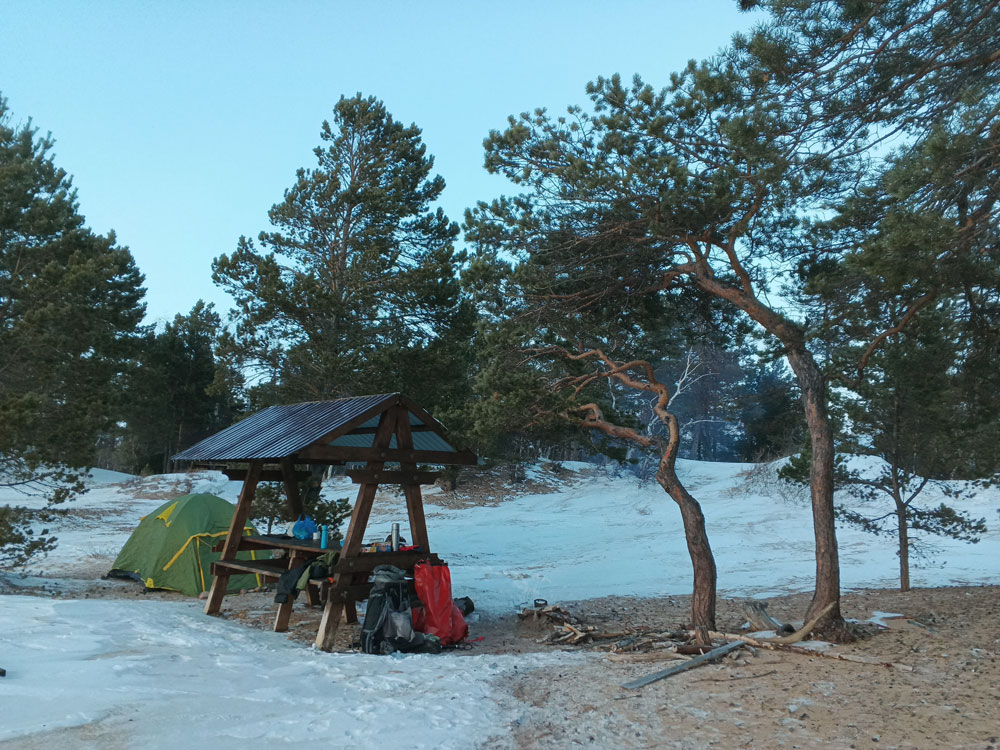
The sun was setting late, so there wasn't a bright sunset, but the night sky was incredibly starry. We saw stars in the sky to a greater or lesser extent every night, but the stars on the first night were considered the brightest.
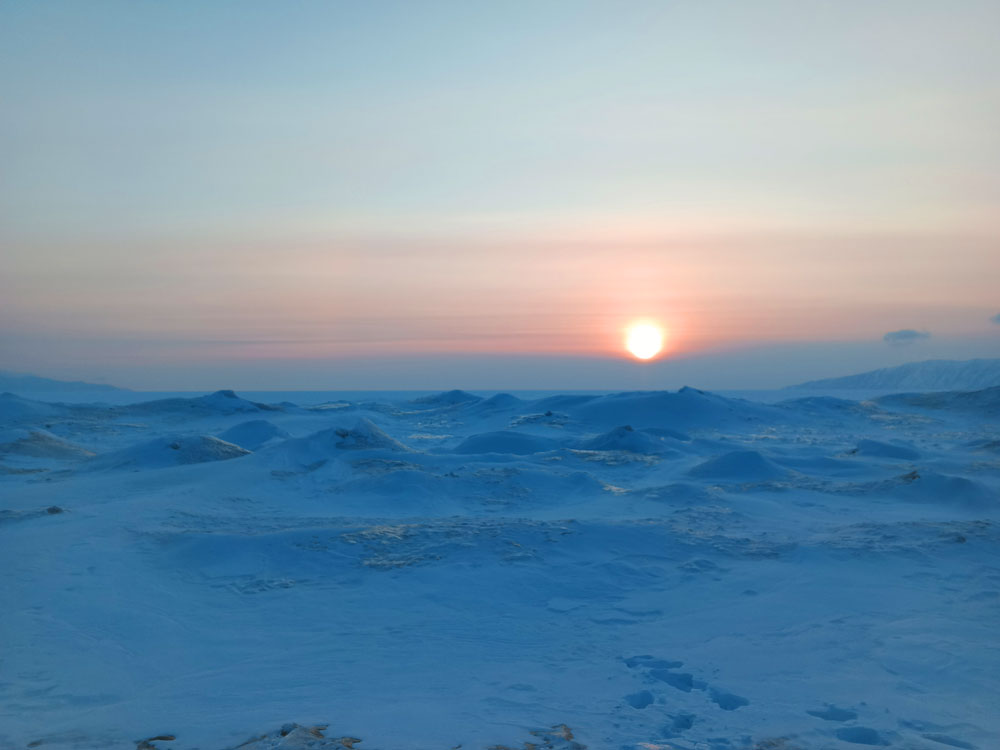
We spent the first half of the second day of the hike following the road deeper into the Chevyruysky Isthmus, and then crossed onto the snow-covered ice of Lake Baikal. And then we encountered the first icy beauty: here and there, blue ice blocks and perfectly transparent vertical ice floes were visible.
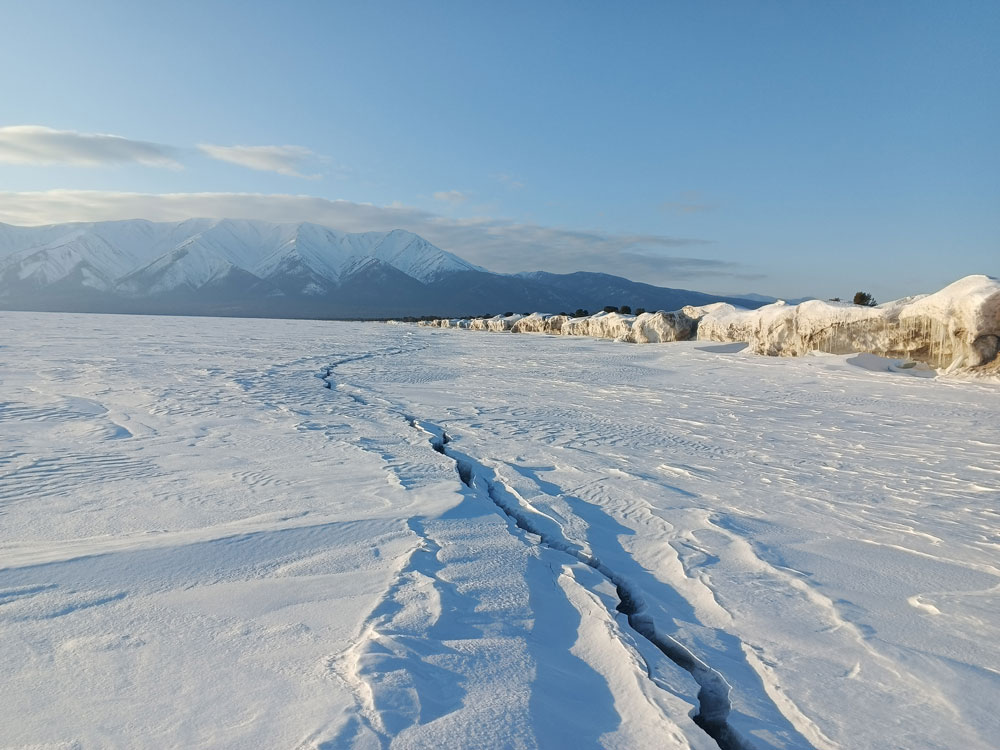
The surface of the lake itself was covered with a hard snow crust, sculpted by the wind into picturesque patterns, and in some places the ice was crisscrossed by winding cracks. This entire texture of the lake's surface was complemented by the backdrop of the mountains located on the Svyatoy Nos Peninsula.
Initially, we planned to walk along the Chevyrkuisky Isthmus to the peninsula and then continue along the coast across the ice of Barguzinsky Bay. However, to save time and optimize the route, we decided to spend the night on the isthmus, about 8 km before the peninsula, so that in the morning we could head diagonally toward the peninsula, cutting a corner and thereby shortening the route. Once again, the shore, rich in firewood, brightened the frosty night with the flames of a campfire.
Day three. We leave the Chevyrkuisky Isthmus and set off across the frozen Barguzinsky Bay. Walking is easy, as the ice is covered with a thin layer of dense snow. Our feet don't sink in or slip; it feels like we're walking on asphalt.
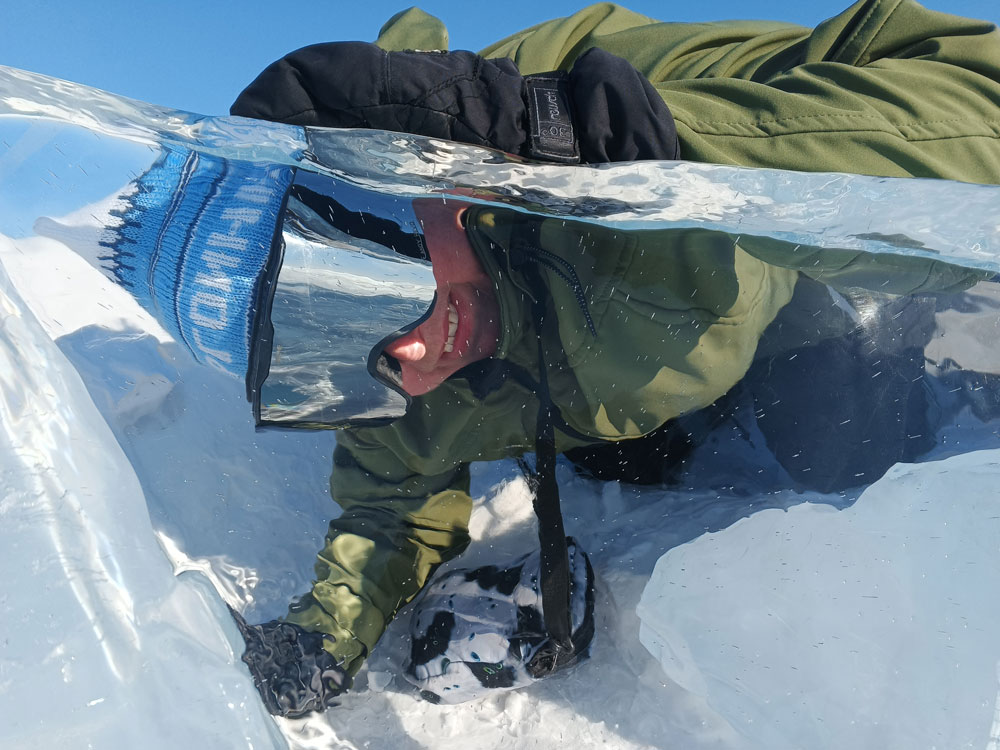
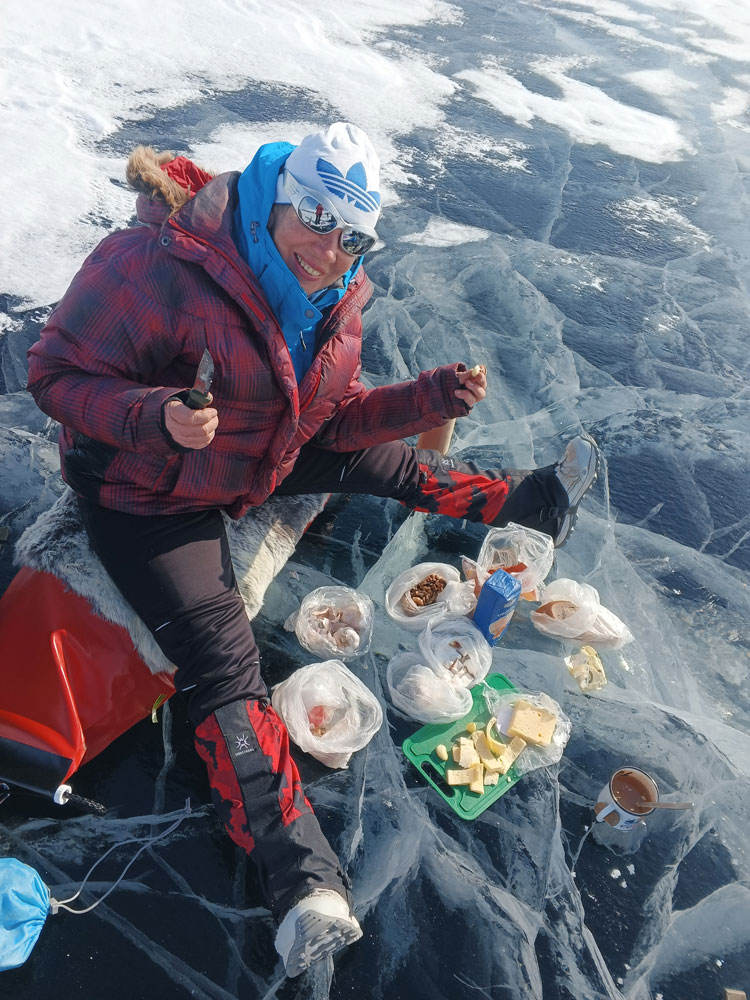
Closer to lunch, we begin to encounter patches of open ice, the same transparent blue with white veins of cracks that has become the hallmark of Lake Baikal. Picturesque ridges of blue and transparent ice hummocks are also present. We choose a patch of smooth open ice for lunch – beautiful!
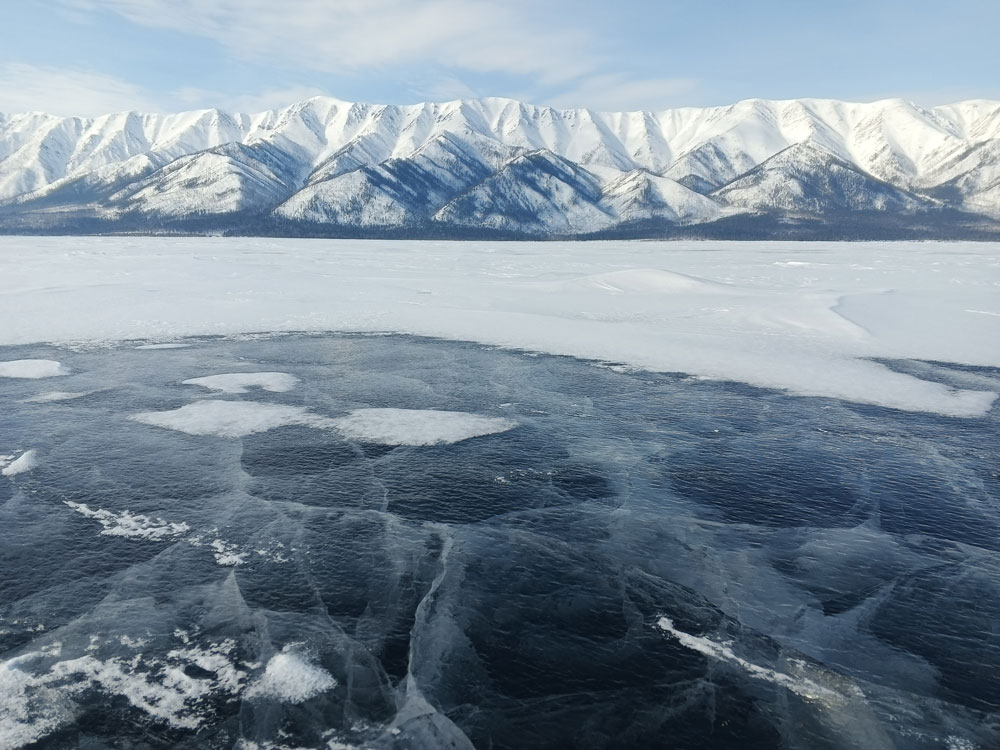
The Svyatoy Nos Peninsula is completely covered in mountains, the slopes of which drop steeply into the waters of Barguzinsky Bay. We observed these picturesque mountains all day, gradually approaching them.
By evening, the question of where to spend the night arose, and we moved closer to the shore to choose something suitable. After the sandy, partially snowless Chevyrkuisky Isthmus, the shore of the Svyatoy Nos Peninsula was clearly inferior in terms of comfort. We had to pitch the tent on a small, relatively flat area in a small bay.
As we approached the shore, large blue ice floes caught my eye, but since sunset had long passed and it was getting dark quickly, we decided to postpone examining them until the morning. Fire preparation at this campsite was also not very good. Despite having plenty of firewood, there was absolutely no suitable place for a fire. There was virtually no open ground, and digging through the snow crust with our plastic shovel was impossible. The shovel deserves special mention. First of all, I'd completely forgotten about it. Remembering it in Ulan-Ude and not wanting to overload my backpack, I bought a lightweight plastic shovel, which was good for nothing more than leveling the powder snow for the tent. Ultimately, building a fire pit was impossible, so the fire we built in a small ice hole quickly died out. Finally, the gas burners' "finest hour" had arrived; fortunately, the frost had eased a bit, and the gas ignited without a problem. We cooked dinner on a gas stove, but sitting on the shore without a fire still wasn't quite so cozy.
In the morning, I didn't really want to turn back to inspect the blue ice floes that had caught my eye the night before. Thinking that something similar would surely await us, we decided to press on. And yes, we were right; there were more than enough blue ice floes ahead. I'd say we would have been happy with significantly fewer. Ahead, from around the corner of the small bay where we'd spent the night, we saw a whole field of blue ice hummocks stretching for several kilometers. While the sparkling blue ice is certainly beautiful, navigating it with a backpack and sleds is a dubious endeavor.
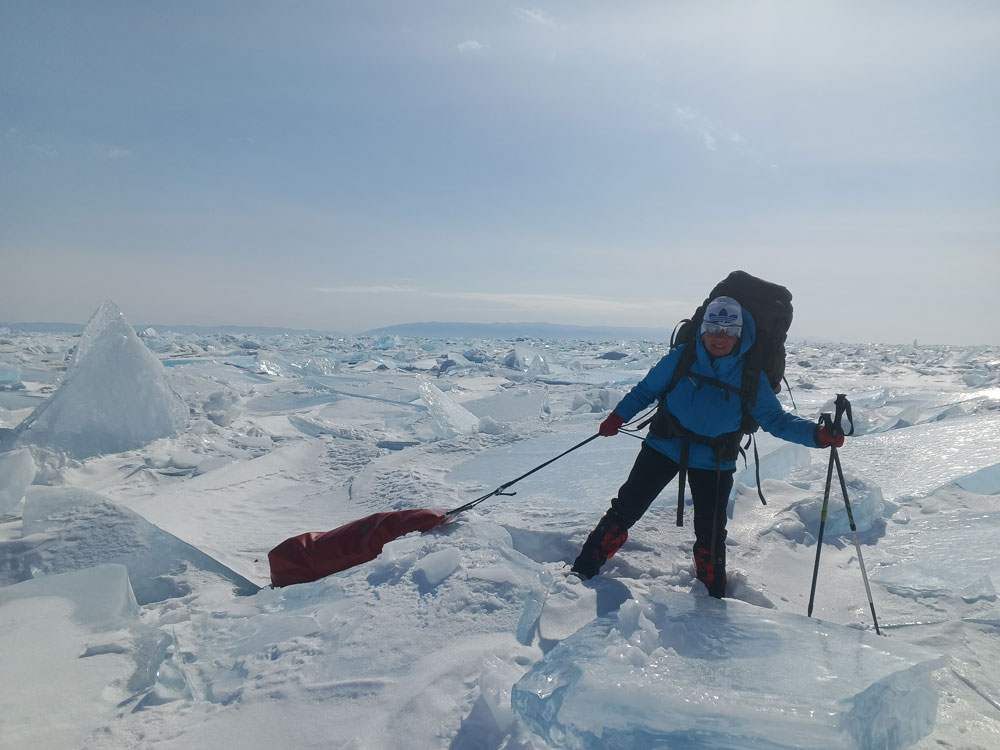
Nevertheless, it was impossible to stop photographing this beauty.
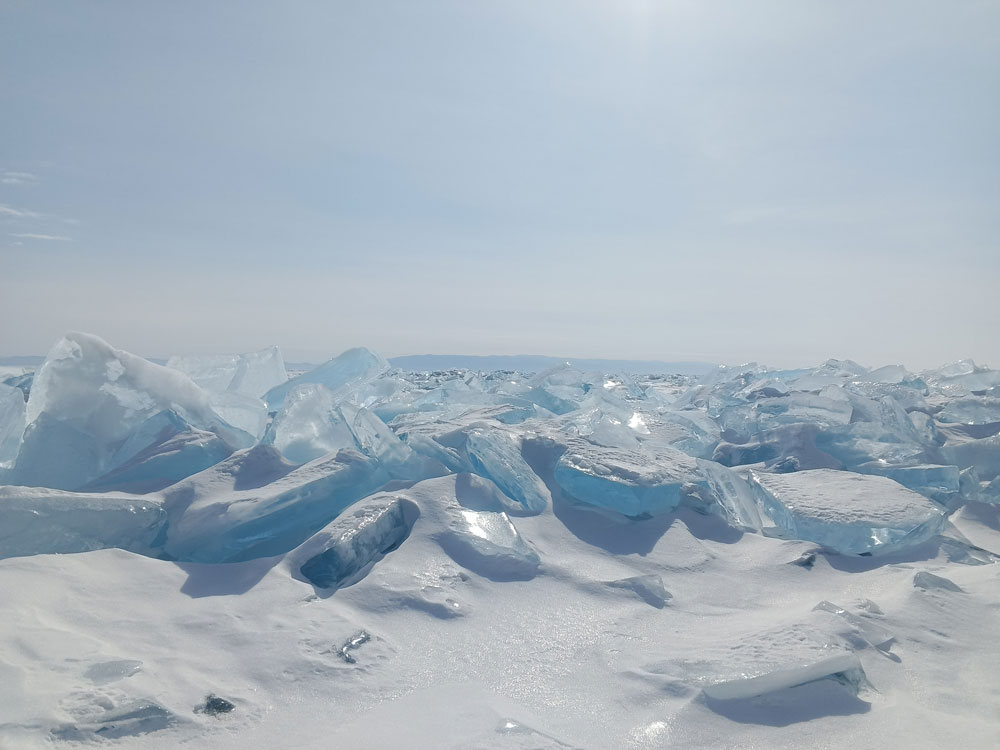
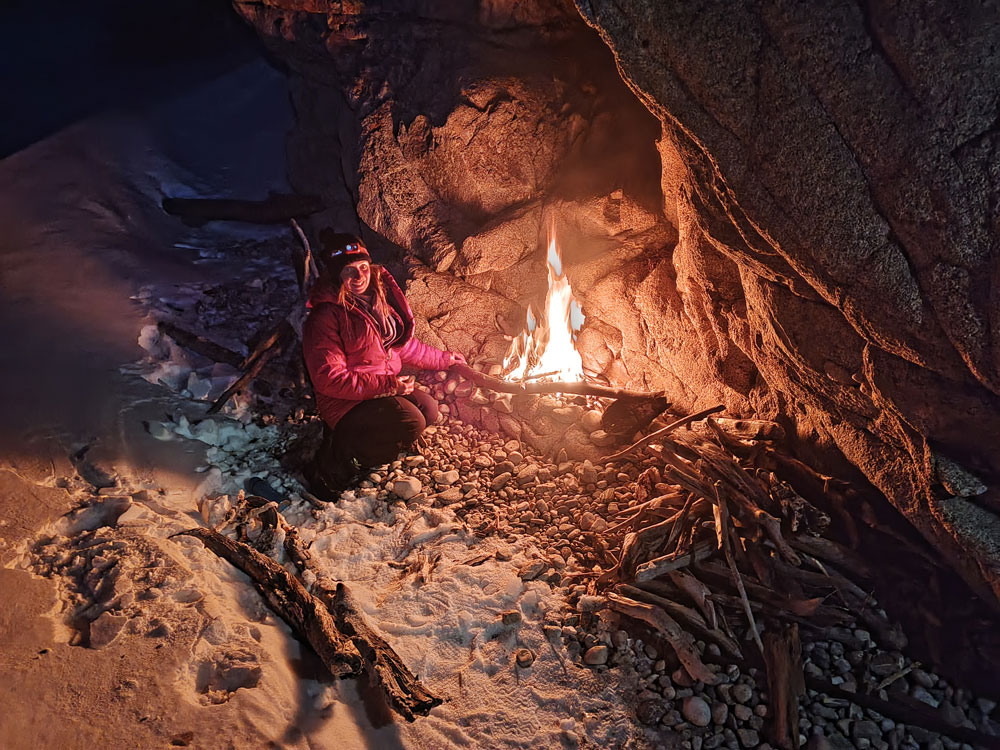
After wading through the thorns of the ice hummocks, we found ourselves at picturesque high cliffs crowned with pine trees. Then there was some more walking with obstacles, after which we emerged onto relatively smooth ice. The day was drawing to a close, but given that the "road" had leveled out, we decided to reach the route's most significant point, Cape Nizhneye Izglovye, the southern tip of the Svyatoy Nos Peninsula. We didn't actually make it all the way to the cape itself, but stopped just outside it. We were drawn to the shore with its stone grotto, perfect for lighting a fire. The previous night had clearly demonstrated that campfires make evenings and mornings much cozier, more comfortable, and warmer.
The ice near Cape Nizhneye Izgolovye is full of cracks. Apparently, strong currents are constantly pushing on the giant ice floes, causing them to move, crush each other, and break. This is why, while near the cape, we constantly heard sounds like explosions. There's no danger in the formation of such cracks; these processes are constant in the ice, but for those unfamiliar with them, the roar was frightening.
The fire in the stone grotto was truly a success. Even after dinner, we didn't want to go back to the tent. We wanted to sit, watch the fire, listen to the crackling of the ice floes, and periodically step away from the fire to observe the starry sky. The stars that night weren't as bright as in previous days, but still much brighter than in the city.
The fifth day of the hike began with a tour of Cape Nizhneye Izgolovye. A tower is visible on the cape—there used to be a weather station here, but we didn't plan to go ashore and inspect the remains of the infrastructure. Climbing the tower wasn't an option, and the remains of other buildings, which, according to previous visitors, remain there, would likely have been barely visible under the snow. We continued across the ice, which here boasts perhaps the most beautiful and colorful shades: from light blue to bright blue.
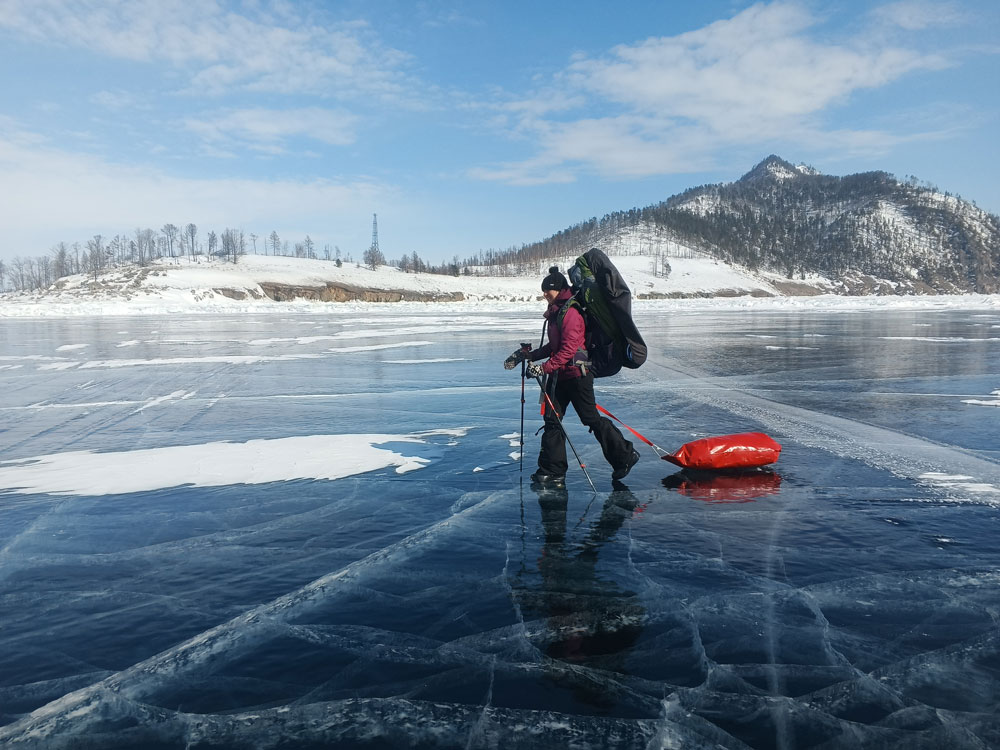
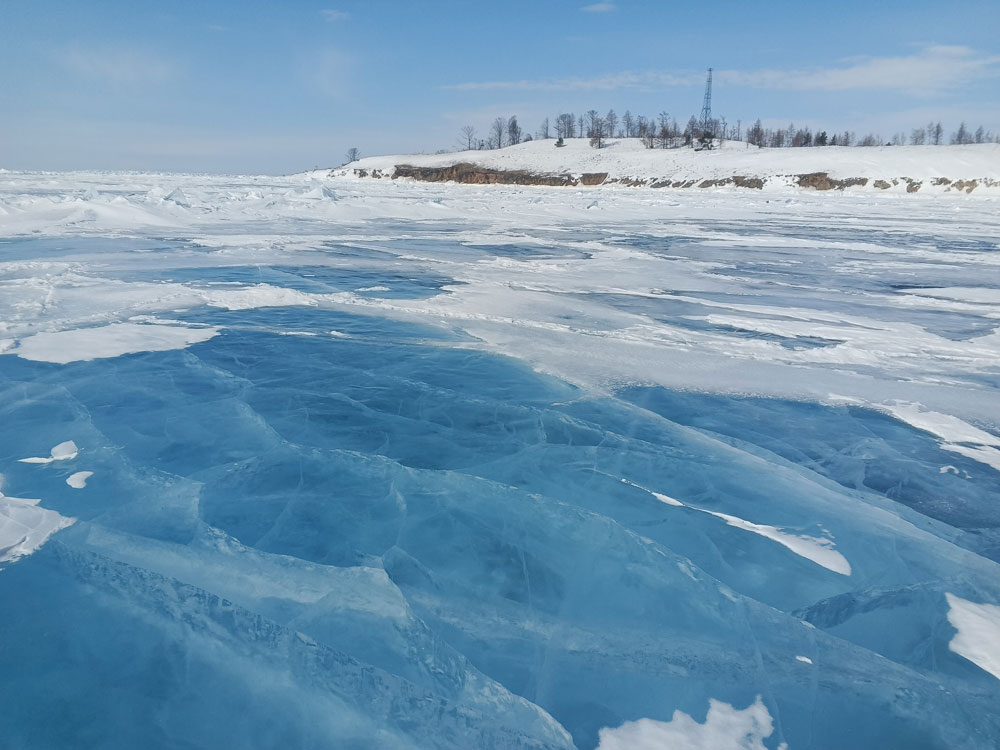
We round the cape and emerge into the Big Sea of ??Baikal. The ice cracks and breaks right beneath us. It's eerie. You know it's safe (cracks in Lake Baikal's ice appear constantly, and they're what create the beautiful patterns that attract tourists), but you still want to quickly get past those spots where the ground rumbles and moves beneath you.
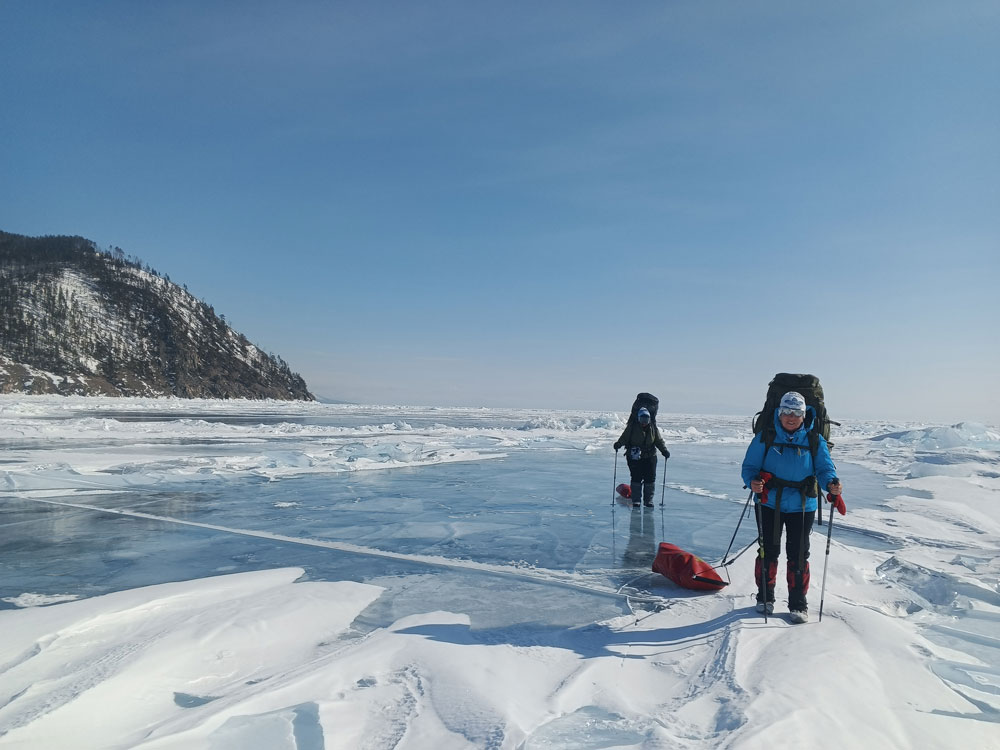
After Cape Nizhneye Izgolovye, our path seemed smooth, with practically no obstacles in the form of ice hummocks. The only obstacles that hampered our progress were slippery patches of bare ice, uneven in places, but compared to yesterday's hopping over the hummocks, this seemed minor. However, one can't say the day had been particularly easy. It was getting on toward evening, and when the question of where to spend the night became urgent, we noticed that we were cut off from the shore by a relatively fresh crack, about half a meter wide. The crack was open, and in places puddles of water spilled around it. In other places, it was blocked by ice floes lying across it. The crack was long and ran diagonally into the lake; there was no way around it, and besides, it had to be done before dark, as traversing such obstacles by flashlight is much less safe. We walked along the crevasse for a while, searching for the safest place to cross. We found a narrow, slightly frozen spot with an ice floe stuck in the middle like a bridge. It seemed possible to jump across, but jumping over a crack, especially with a backpack, was a dubious idea. It was better to quickly step on the frozen floe and cross to the other side of the crevasse. I did this instinctively, without thinking; for some reason, it didn't occur to me that there was any other way to proceed in this situation, so I didn't comment except to point to the crossing point and say, "This is fine!" Confident that everything was fine, I took a few steps away from the crevasse, but turning around, I saw Olga, who was following me, stepping on the edge of the crevasse and sinking one foot into water about knee-deep. My instincts told me to rush to help, but approaching someone falling through the ice was a bad idea; it could worsen the situation by putting additional stress on the ice. Luckily, Olga managed to cope with the situation on her own and got out of the water. But she emerged on the same side she'd originally been on, meaning two of us were still on the opposite side of the crevasse and needed to somehow get across to me. We moved away from the crevasse, taking different directions to give ourselves time to think. We decided to walk a bit along the crevasse to look for a more convenient crossing spot, but that didn't seem likely in the near future, and venturing far into the unknown, being on different sides of the crevasse but with only one tent for three of us, wasn't something we wanted to do at night. I decided to go back and organize the crossing where I'd crossed, but this time with more precise instructions. The plan worked; we all ended up on the same side of the crevasse and headed toward the shore in search of a place to spend the night.
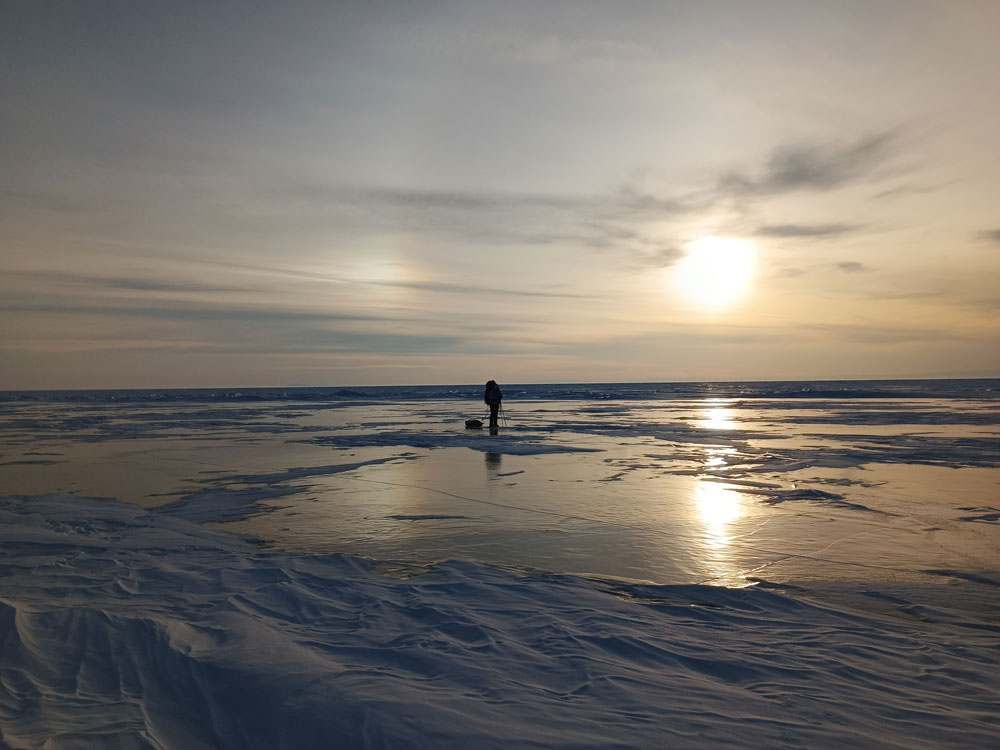
When choosing a campsite on the shores of winter Baikal, I was primarily guided by the availability of land clear of snow, as it is impossible to start a fire in the snow without a proper shovel. That day, land was found, albeit on a rather steep slope, and there was, as usual, plenty of firewood on the shore. We not only cooked dinner but also made delicious dried fruit compote. Once again, I note that a campfire offers unlimited cooking possibilities, unlike gas, which must be used sparingly. Incidentally, everything cooks much faster over a campfire. With a fire, you have unlimited tea, hot water for washing dishes, and warm toasted bread... Speaking of bread, this was the first hike in my life where our bread froze! We usually take bread for the first couple of days, then switch to biscuits; they're lighter, don't go stale, and don't spoil. It was the same this time: we took two halves of round biscuits with us for the first time, but eating them turned out to be quite difficult, as the bread froze through and became completely hard. We had to eat the biscuits during the day and defrost the bread over the fire in the evenings. A life lesson learned: on a winter hike without a fire, you shouldn't take bread, even as a treat.
The sixth day of our hiking trip didn't feature any notable obstacles. After the crack, we were reluctant to venture far from the shore, lest we become cut off again, but the occasional hummocks or uneven shoreline forced us to do so. The ice still cracked, sometimes right under us, but not as loudly or frequently as near Cape Nizhneye Izgolovye. It was sunny and quite warm, with occasional gusts of wind, but they died down by evening. Credit where credit is due to the Baikal winds. Even though the days were generally windy, sometimes even a lunch break was unwelcome, and the tea and broth in our cups cooled instantly. By evening, the wind died down, and we pitched the tent almost always in calm weather. Considering our limited means for securing the tent (we couldn't stick stakes into the snow, poles didn't stick easily into the snow-ice mixture, trees and bushes were generally absent on the flat part of the shore, and rocks and logs weren't readily available at every campsite), the calm night was quite beneficial.
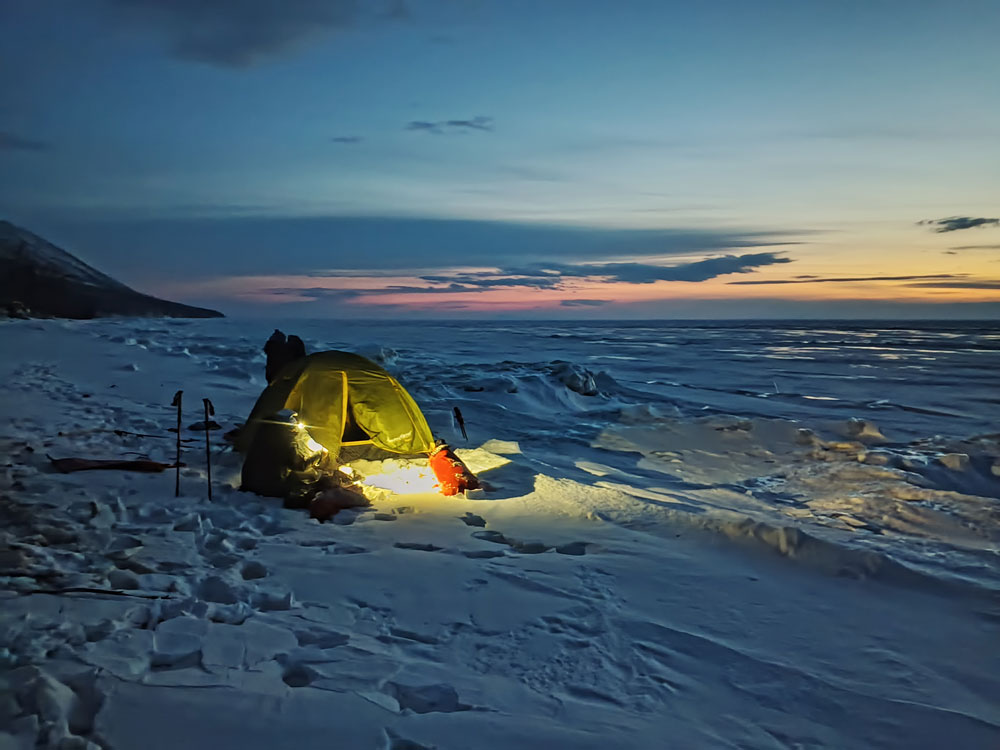
We chose a very interesting and beautiful spot for campsite number six. Firstly, it was located directly opposite the Ushkany Islands. A stopover was originally planned, but given our progress, which was slower than expected due to a significant number of obstacles, we had to abandon the plan. Secondly, we settled under a picturesque pine tree, with a convenient spot for a fire and plenty of firewood. We were once again delighted by the stars and the young, pointed crescent moon.
But there was also disappointment: the warmth we'd anticipated during the first, coldest nights had left the snow damp and some of our gear soggy. We all agreed that the cold was more comfortable than the damp. The warmer weather had only one significant advantage: chores like setting up a shawl could now be done without mittens or constantly warming our hands over a fire.
Meanwhile, we had two days of hiking left, and still had a long way to go (over 40 km). While this might not seem like a long distance, experience from the previous days showed that, firstly, our average pace was slower, and secondly, who knew what other surprises awaited us. In planning this trip, I was guided by my experience with the 2022 winter trip to Lake Baikal, where we averaged 30 km per day. But that hike took place near Olkhon Island, in areas well-trodden and well-traveled by tourists, and for most of the journey we walked practically on the road (smooth and compact, without significant obstacles). This time, things were different: crossing and avoiding hummock fields, as well as slippery and uneven ice, significantly reduced our average daily mileage. In light of this, we decided to set out earlier the last two days. The first day wasn't a great one, as some participants' shoes, wet the day before, literally froze over and required warming them over a fire to defrost. We set out just an hour earlier than usual. The first half of the day was pleasantly uneventful, and we made fairly quick progress, but in the afternoon, the situation spiraled out of control. After turning around another small cape, we found ourselves in a region of small bays, separated from the main lake by a ridge of high hummocks. This is likely why a large amount of snow had accumulated in these bays (the ice hummocks simply prevented it from being blown away by the wind, as happens over most of Lake Baikal's surface). Going around the ice hummocks from the other side was pointless – they extended too far into the lake. We had to push through the snowdrifts.
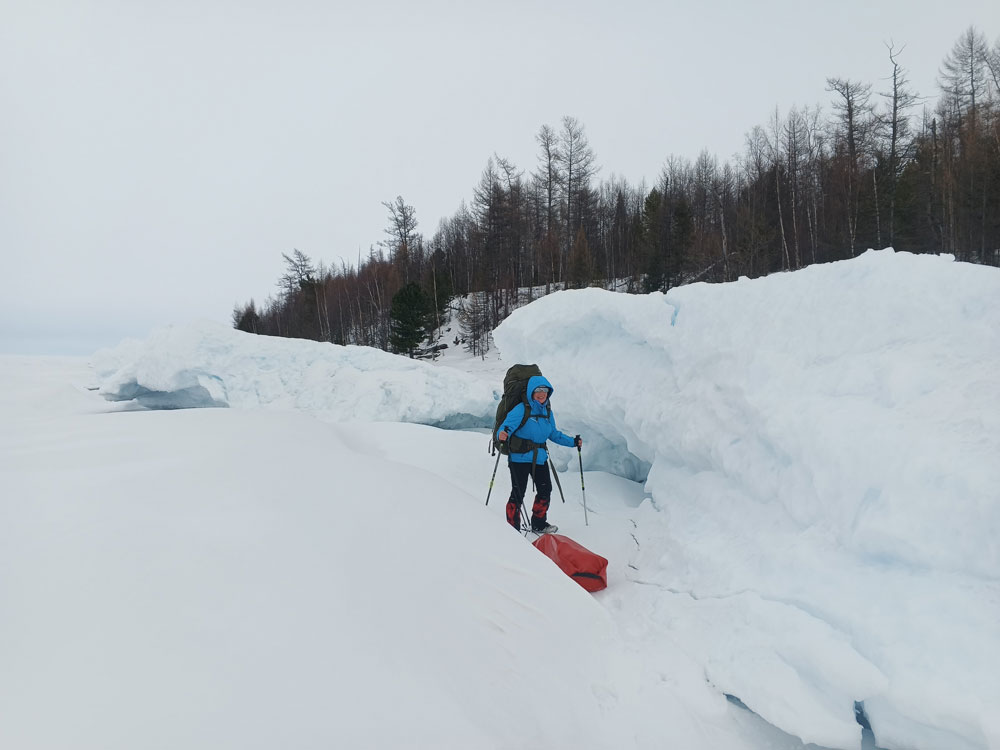
We walked, constantly sinking into ankle-deep snow, and sometimes even deeper. Naturally, our speed slowed. We originally planned to reach the northernmost point of the peninsula that day—Cape Verkhneye Izgolovye, beyond which our "finishing stretch" across the ice of Chevyrkuisky Bay would begin—but by midday it became clear that these plans were destined to fail. We adjusted our plans to simply walk as far as possible until dark, stopping wherever darkness caught us, with no pretensions to a comfortable campsite with a fire, just on the ice. If the surface underfoot had been smoother, we could have continued on in the dark, but with snowdrifts of unknown depth, hummocks, and cracks beneath our feet, continuing in the dark was unsafe.
We hiked almost until dark that day, but still hoped to find a decent camping spot. After sunset, we approached the shore, spotting a couple of spots on the slopes with bare ground. However, upon closer inspection, it turned out the path to the shore was blocked by huge ice floes, which would have been quite difficult to climb over, especially with backpacks and sleds (behind the floes, there was an additional obstacle in the form of a large ice ravine). After running along the shore for a bit, searching for at least a manageable passage, we decided to pitch our tent right on the ice. The location wasn't exactly ideal—in a small bay, close to the shore, on a flat surface of ice. It was just not very comfortable, though. It was difficult to light a fire. But since the weather was quite warm (around freezing or slightly below zero) and there was no wind, the lack of a fire didn't seem like a critical drawback to a potential overnight spot.
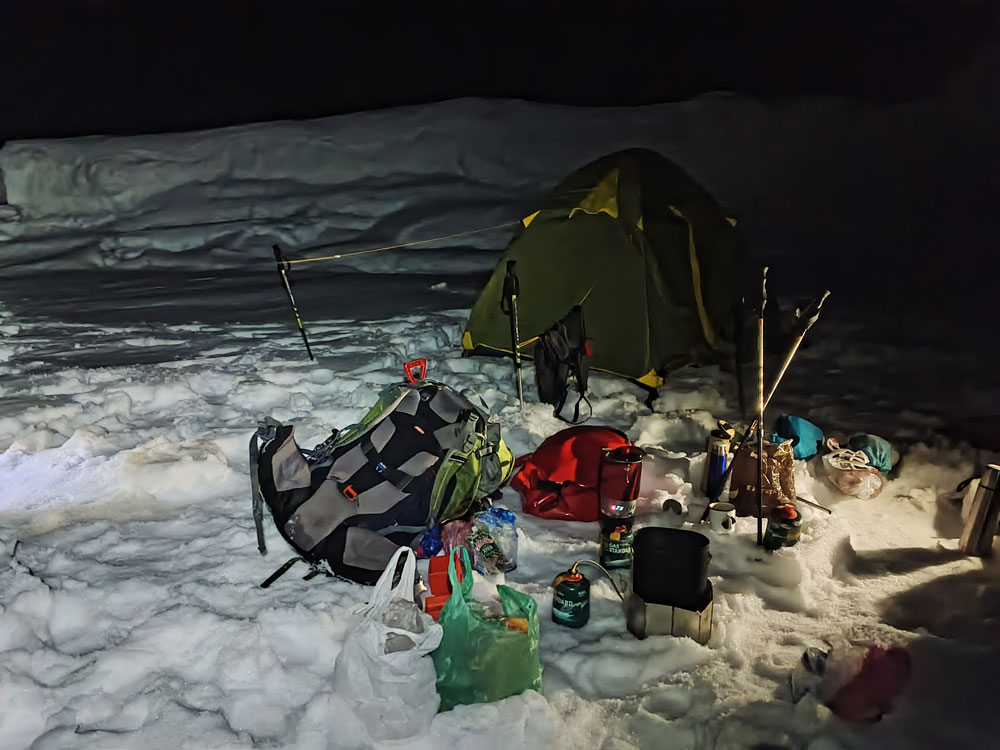
Interestingly, it was at this very campsite that something happened to me that became one of the most vivid memories of the hike, although, at first glance, there was nothing special about it. Alone near my tent that evening, pouring the last of my hot tea into a cup, I looked around and saw the following scene: I was standing on the frozen surface of Lake Baikal, the flashlight glowing silver steam rising from the cup in my hands. Through the veil of steam, I could see the sky, still barely light after sunset, with scattered dark clouds, twinkling stars, and a new moon. Perhaps this is the scene I remember most from the entire hike. Yes, you don't have to hike for a week and spend nights in the cold to see a beautiful starry sky, but believe me, a starry sky, no matter how beautiful, viewed from a viewing platform outside the city, reached, say, by car, is significantly different from the starry sky you see when you've hiked for about a hundred kilometers and are practically alone (except for a couple of friends in a tent) under that starry sky on the shore of the deepest lake on Earth. The value of a cup of hot tea in this case also increases severalfold. This was our last night on this trip.
The morning began early. Given our lag behind schedule and the unfavorable ground underfoot, which threatened to further slow our progress toward the finish line, we decided to rise at 5:00 a.m., skipping breakfast at camp to speed up packing, and instead eating it en route during one of the rest stops. We hoped that the snowdrifts would collapse under us less in the morning than they would during the day, when the sun warmed them.
Unfortunately, our hopes were dashed; the snow was quite deep and collapsed just as much as the day before. Furthermore, hummocks, snowdrifts, and crevasses kept appearing along the way, which we had to step over or go around. Our overnight stop was about five kilometers from Cape Verkhneye Izgolovye, a distance that took us about three hours.
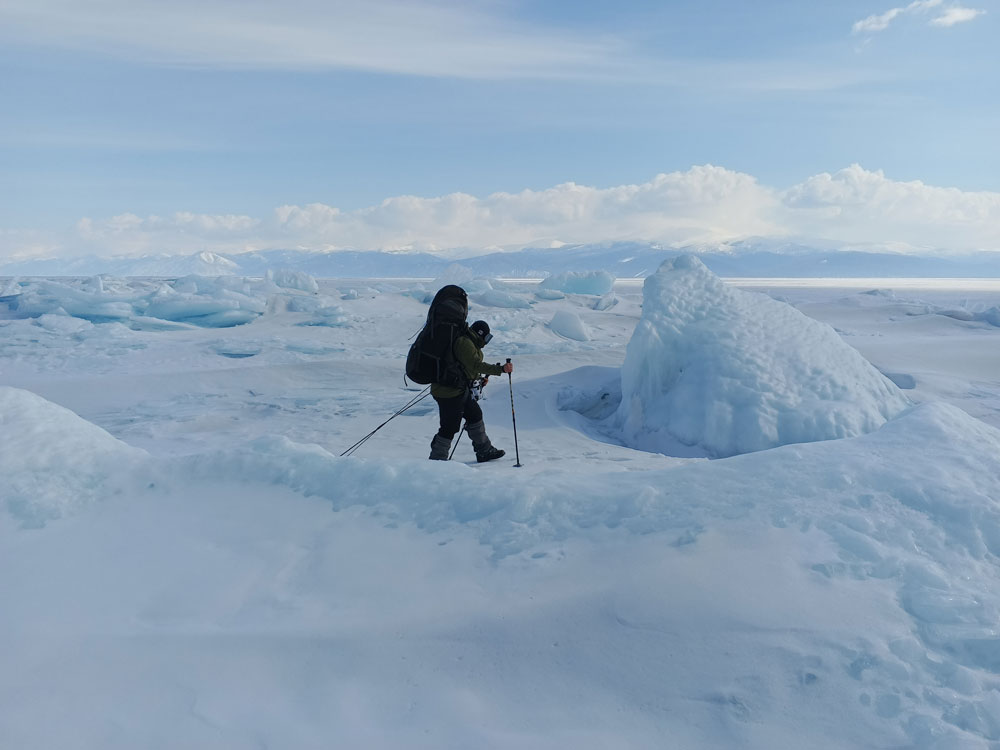
Having reached the cape, despite our fatigue, we couldn't help but admire the beauty of this place: large ice floes glittering in the sun, smooth, sparkling snow, green pine trees lining the shore... We stopped at this beautiful spot for breakfast and rest, hoping that an easier route would await us beyond the cape.
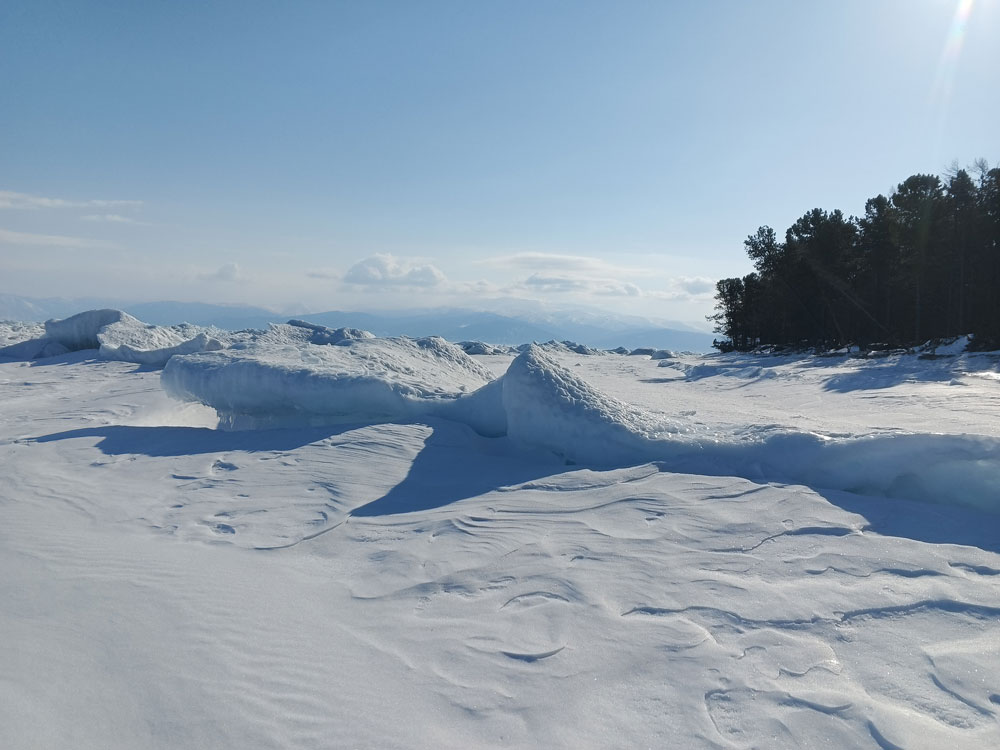
This time, our hopes were fulfilled. Chevyrkuisky Bay delighted us with smooth ice, lightly covered with shallow, compact snow. The walk was a pleasure, especially after our morning's ordeal. I can't help but remark on the natural beauty of Chevyrkuisky Bay. Rocky, sometimes steep, shores, picturesque islands and mountains on all sides (except for the open side of Lake Baikal, of course). The sun shining in a cloudless sky and the continued complete absence of people added to the beauty. For some reason, we thought that here, about 20 km from the nearest settlement, Kurbulik, and even closer to the popular hot springs in Zmeinaya Bay, there would already be a bustling scene, but to our delight, this was not the case. We continued to enjoy the beauty of nature, alone with it.
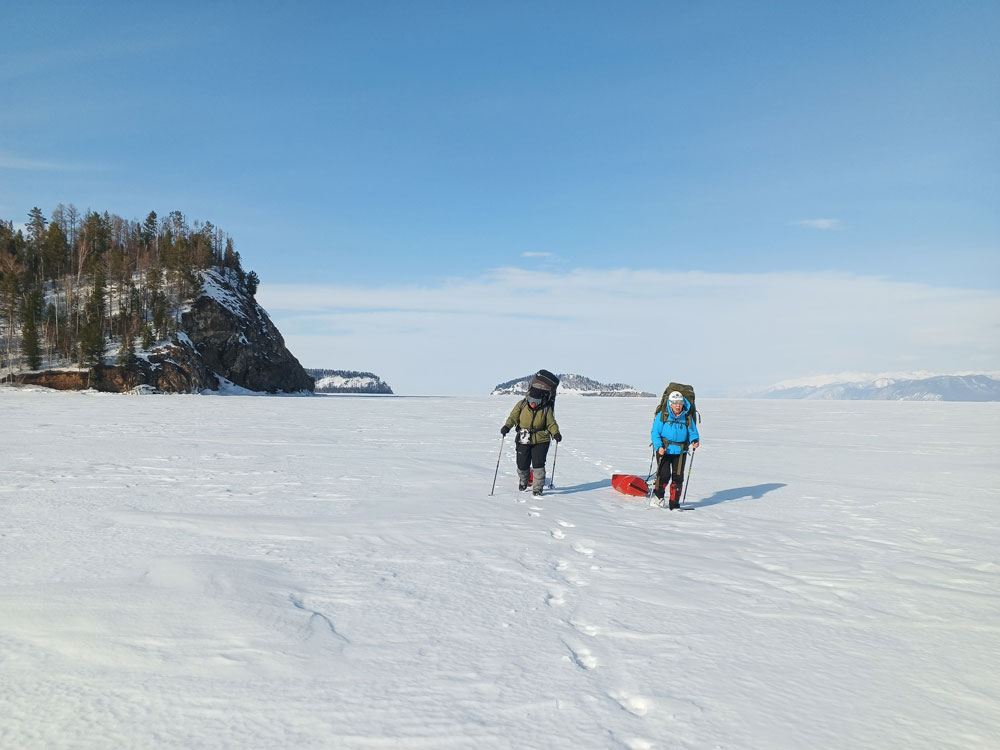
A little later, we noticed a road with cars driving on it, but it ran along the opposite shore of the bay, about 10 km away, and did not in any way disturb our solitude. By mid-day, we realized and became confident that by sunset we would reach Zmeinaya Bay, where we could swim in the hot springs and where we could call a car to take us to the village of Ust-Barguzin, and we continued on our way, no longer in a hurry.
The hot springs were a welcome relief after eight days of hiking. They were the icing on the cake of our trip.
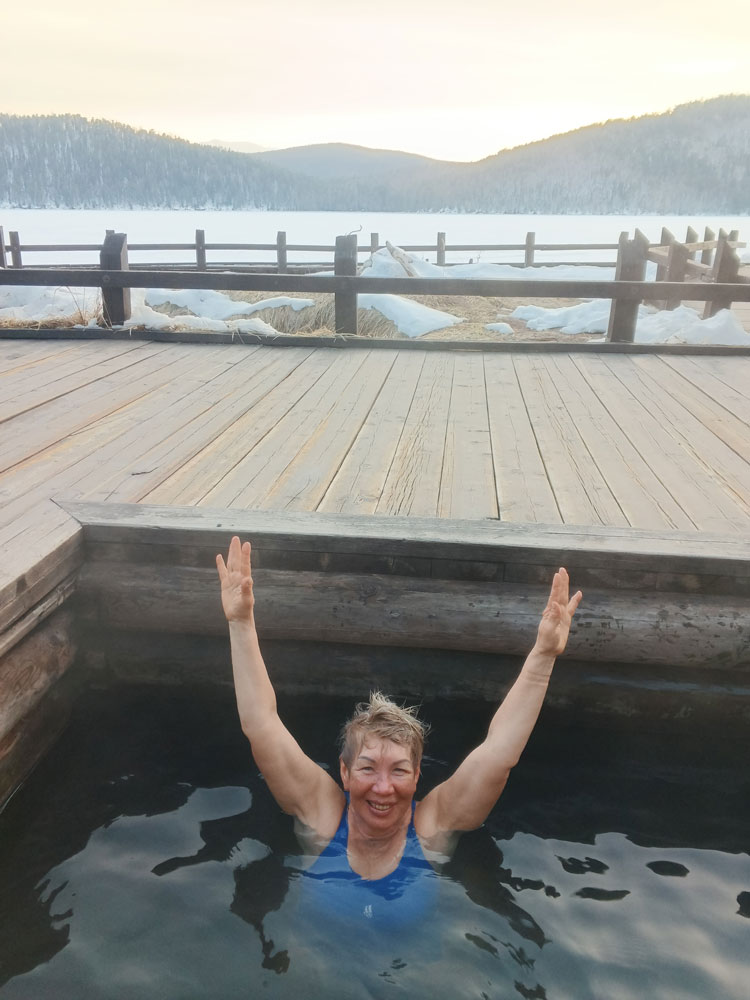
Well, that concludes my story about the hike around the Svyatoy Nos Peninsula on Lake Baikal. As always, after a challenging expedition, I can't help but thank my dear participants who made this ambitious undertaking possible. Olya and Marina – you're amazing! Thanks to people like you, travel doesn't turn into tours, but remains authentic!
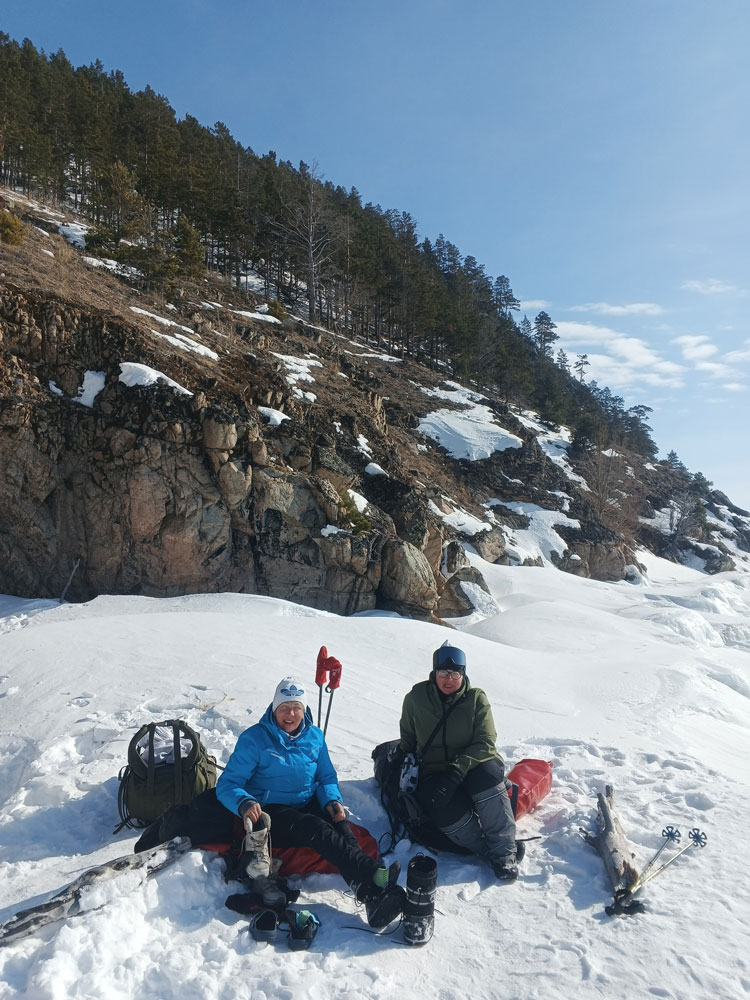
If you are interested in traveling to the Svyatoy Nos Peninsula at a different time of year (not in winter), you can join the Buryatia Road Trip from October 1 to 11, 2026, during which we will drive to Svyatoy Nos, where we will first admire the panorama of Chivyrkuisky Bay from the observation deck in the village of Monakhovo, and then head to the highest point of the peninsula - Mount Markova, 1878 m high. The climb is quite steep and will require a lot of effort and time from us (about 5-6 hours) It's a 2-3 hour hike there and back, with an elevation gain of 1,400 meters (4,500 ft), but the views from the summit are worth the effort. We'll see panoramic views of Chivyrkuisky and Barguzinsky Bays and the isthmus between them, and on the other side, the endless expanses of open Lake Baikal and the silhouette of Olkhon Island, about 80 km away. Mount Markov also offers excellent views of the Ushkany Islands—a protected archipelago of Lake Baikal, home to the lake's largest rookery of nerpa, the Baikal freshwater seal.