Vorkuta Ring Road Tour
atmospheric abandoned buildings, polar day and northern nature
Tour dates: June 13-18, 2027
For today, November 09, 2026, 7 places from 8 are available on this tour.
Europe's easternmost city, one of the largest cities north of the Arctic Circle, and yet, at the same time, the city with the fastest population decline in Russia. A city with no roads and accessible only by train or plane. A city that has experienced rapid growth, prosperity, and decline in less than 100 years. This is Vorkuta. Vorkuta and its surroundings attract lovers of Soviet history, industrial landscapes, atmospheric abandoned buildings, and the picturesque northern nature. A trip to Vorkuta can evoke conflicting emotions, but it will leave no one indifferent. An added bonus is that we're traveling to Vorkuta in June, at the height of the polar day. During our trip, the sun won't set once. A week-long day—isn't that a miracle?
Trip Organizer:
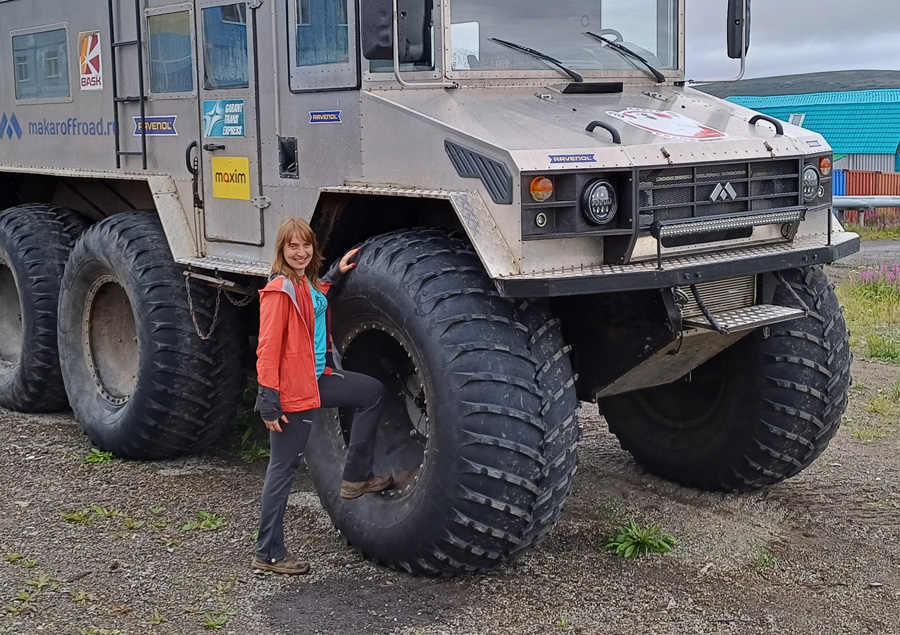
VIKTORIA SHATALOVA
Professional traveler, author's trip organizer with 17 years of experience. She has visited 40 countries around the world and 83 regions of Russia. Organizer and participant of numerous hikes, rafting trips, car trips, ascents, including the ascent of the highest and most dangerous volcano in Eurasia - Klyuchevskaya Sopka (4850 m), ski trips in the northern and subpolar Urals, the Murmansk region and the Kuznetsk Alatau.... Read more
Itinerary day by day:
Vorkuta
Arrival in Vorkuta. The most convenient way to get to Vorkuta is by train. Flights to some cities are available, but flights are not daily and usually require transfers. Upon arrival, we'll check into a hotel or apartment and set out to explore the city. Vorkuta can safely be called an open-air monument to Soviet architecture. Built in the mid-20th century, the city seems frozen in time. We'll see numerous sculptures and monuments from the Soviet era. Vorkuta probably leads the country in the number of surviving Soviet signs and slogans. Vorkuta has 12 squares, which is quite impressive for a relatively small city. Each square has its own unique appearance, monuments, and history. Despite the fact that Vorkuta's population has halved over the past 30 years, Vorkuta remains fourth on the list of the world's largest cities above the Arctic Circle.
Vorkuta - Rudnik
We continue our exploration of Vorkuta at the Vorkuta Museum and Exhibition Center. The museum boasts a wealth of materials detailing the city's history, which is inextricably linked to the development of coal mining in the region. An important chapter in this history is associated with the Vorkuta Correctional Labor Camp, whose prisoners built the Arctic coal capital.
After visiting the museum, we head to the place where Vorkuta's history began—the village of Rudnik, located on the opposite bank of the Vorkuta River. The village, which in the 1930s launched the development of the entire Pechora Coal Basin, is now completely uninhabited. We'll experience the history of this area by strolling among abandoned buildings. Here you'll find typical Khrushchev-era buildings as well as earlier buildings in the Stalinist Empire style, such as the Geological Administration building. The outstanding geologist Viktor Fyodorovich Morozov, whose coal exploration methods are still used today, is buried in the village's memorial cemetery. Rudnik is separated from the residential part of Vorkuta by only the relatively narrow Vorkuta River, making the abandoned Rudnik building an excellent vantage point overlooking the city. An active railway line to the Vorkutinskaya Mine also passes through the village. After leaving the abandoned village, we'll take a walk along the high bank of the Vorkuta River and enjoy the natural beauty of the surrounding area, which blends harmoniously with the industrial sites.
Overnight in Vorkuta.
Vorkuta Ring: Zapolyarny - Komsomolsky - Vorshagor
We're setting off on a journey along the Vorkuta Ring—a chain of mining settlements that served the coal mines located around Vorkuta. Due to the closure of most of the coal mines after the collapse of the USSR, the population of these settlements has significantly decreased, and some have been completely resettled and are now uninhabited, preserving the history of these places among their abandoned houses. We'll begin with the settlement of Zapolyarny. According to unofficial estimates, as of 2025, this settlement, once home to 10,000 people, had a population of only about 400. Zapolyarny once boasted four schools (including a children's music school), five kindergartens, shops, a hospital, a clinic, a sanatorium, a community center, a community center (with a cinema and library), a restaurant, a cafeteria, a café, a beer hall, a gym, an indoor skating rink, a shooting range, a post office, a bathhouse, a pharmacy, and even a distillery. All of this now lies in disrepair. However, the Zapolyarnaya mine, which gave birth to the settlement, remains operational to this day. The Pechorskaya Central Processing Plant also operates in the settlement. Coal products are shipped from the operating Mulda station, which is, incidentally, the northernmost station on the Northern Railway.
After exploring Zapolyarny, we head towards Komsomolsky, stopping along the way at the settlement of Zapadny, which was completely vacated in the early 2000s and is now almost completely destroyed.
Komsomolsky is a fairly large village; in its heyday, its population reached 15,000 people, but it is now completely vacated. Wandering among the deserted houses, you can encounter schools, cafes, shops, and sports facilities, with their signs still intact. Komsomolsky's most striking landmarks are the stele with the slogan "Peace to the World" and the vibrant mosaic depicting it in the Mir Cinema building.
Next in line is the village of Vorshagor, the largest and most vibrant of the villages on the Vorkuta Ring Road. Vorshagor's population is approximately 6,000, which is quite large by the standards of the Vorkuta Ring Road. However, this is only a fifth of the population during its heyday, so even here, residential areas coexist with post-apocalyptic abandoned buildings. The village has a museum, and its signature landmark is the futuristic "Coal" stele, erected in 1985 to commemorate the 50th anniversary of the Stakhanovite movement and the 10th anniversary of the opening of the Vorgashorskaya coal mine.
Vorshagora offers daily rental accommodations, although the supply is limited. We will try to arrange an overnight stay in Vorshagora so that we can continue exploring the villages of the Vorkuta Ring the following day without returning to Vorkuta.
If there are no current accommodation offers in Vorshagora, we will return to Vorkuta for the night.
Vorkuta Ring Road: Promyshlenniy – Yur-Shor – Sevrniy – Cementnozavodskiy – Oktyabrskiy
First, we'll pass a couple of abandoned villages: Promyshlenniy and Yur-Shor. Near Yur-Shor, there are several memorials: a monument to those killed in the 1998 Tsentralnaya Mine accident, as well as a cemetery for prisoners of the Vorkuta labor camp with monuments. Next, we head to Sevrniy, which, compared to many villages on the Vorkuta Ring Road, is quite residential. It has a population of about 3,500 and a functioning school, kindergarten, clinic, community center, and thermal power plant. Among the Soviet-era monuments are a stele at the entrance to the village, a community center, a traditional Lenin monument, a Lenin mosaic on the thermal power plant building, and an ice rink, built in 1964 as a round building with a unique natural ice cooling system through openings along the perimeter of the building, allowing cold air to penetrate from below. The rink is still in operation today, unfortunately only in winter. Among the partially dilapidated Soviet-era buildings, the Church of the Holy Blessed Prince Igor of Chernigov, built in 2003, stands out. Of particular interest is the memorial to those who died in the 2016 Severnaya Mine accident.
Another almost completely abandoned village on the Vorkuta Ring is Cementnozavodsky. The village's main enterprise closed relatively recently, in 2017, so the village has many well-preserved buildings, and many apartments still have some of their furnishings. As of 2021, several families still lived in the village. We'll complete the Vorkuta Ring by passing through the completely abandoned and destroyed village of Oktyabrsky, after which we'll return to Vorkuta.
Pemboy Rocks – Khalmer-Yu Waterfall – Khalmer-Yu Village
A beautiful, long, and action-packed day awaits us, fortunately for us, the June polar daylight hours are unlimited. We set off to explore the beautiful nature surrounding Vorkuta. We'll drive in all-terrain vehicles to the tundra to see the Pemboy Rocks and the waterfall on the Khalmer-Yu River.
Pemboy is a picturesque, curved ridge stretching for seven kilometers. From a geological perspective, it is a unique monument, approximately 250 million years old. The rocks acquired their unusual shapes thanks to frost weathering. At the very summit of Mount Pemboy, there's a helipad and observation tower, offering a stunning view of the endless tundra—motley meadows, boulder fields, and lakes with crystal-clear water.
The next natural attraction is a waterfall on the Khalmer-Yu River, approximately 10 meters high and consisting of three steps. At the drop point, the river narrows, forming a short but fairly high rocky canyon with sheer walls, where the powerful flow has formed stone bowls filled with clear water.
We'll also stop by another ghost town—the village of Khalmer-Yu, resettled in 1995 after the coal mine closed and serving as a military training ground since the 2000s.
After a busy day, we'll return to Vorkuta.
Домой
Departure day from Vorkuta. Trains usually depart in the afternoon, so we'll have the opportunity to buy souvenirs and food for the trip. A delicious souvenir from Vorkuta would be venison delicacies from local producers.
Organizational fee:
950 Euro (until December 31, 2026)
999 Euro (from 01.01.2027)
Organizational fee include:
- Accommodation in hotels or rented apartments for the entire trip;
- Transportation by car and all-terrain vehicle for the entire trip;
- Visit to museums and attractions listed in the itinerary;
- Travel organizer available 24/7;
- Driver available.
Organizational fee NOT include:
- round-trip tickets to Vorkuta;
- food;
- health insurance;
- Accommodation before and after the start date of the trip;
- Clothing and personal equipment of participants;
- Participants' expenses related to force majeure circumstances (including delays due to equipment breakdowns or bad weather);
- Souvenirs and other personal expenses of participants;
- other expenses not listed in the "included in the price" section
The trip is easy and suitable for almost anyone. Most of the travel will be by public transport. Light walking is included, with a maximum of 6 km per day.
Read moreWe're heading to Vorkuta in mid-June, but by northern standards, it's more like late spring than summer. Temperatures at this time of year range from 10 to 16 degrees Celsius during the day and from 2 to 8 degrees Celsius at night. The tundra can be damp, and there may still be snow in the lowlands and gorges, so we'd like to remind you to pack warm clothing for the temperatures. Be sure to pack an insulated, windproof jacket, a wool or fleece sweater, and perhaps a set of thermal underwear, gloves, and a hat. Make sure your footwear is comfortable and waterproof. Warm and comfortable clothing is essential, as we'll be outdoors for a significant amount of time. Don't forget rain gear and insect repellent.
1. If you are interested in this trip, please submit a request using the form below or send us a message via messenger. We will contact you and answer all your questions.
2. To reserve a place, a 30% advance payment of the registration fee is required. This advance payment is refundable 45 days or more before the trip start date and, unfortunately, non-refundable if it is made less than 45 days before the start date if the refund is due to your cancellation (for any reason). If the trip is cancelled due to our fault, a group not forming, or force majeure, your advance payment will be refunded in any event.
3. Round-trip train tickets to Vorkuta, including transit tickets (if required), are purchased by participants themselves!
4. Final payment is due seven to three business days before the trip start date.
© The program description uses photographs by Evgeny Androsov and Victoria Shatalova.